The Struggle for Lisbon’s Brazilian Carnival and Against Structural Xenophobia
Andrew Snyder
Institute of Ethnomusicology – Centre for Studies in Music and Dance, NOVA University Lisbon, Portugal
Correspondence: asnyder@fcsh.unl.pt
Abstract
Since the mid-2010s, Brazilian immigrants have celebrated carnival festivities in the streets of Brazil’s ex-metropole, Lisbon, Portugal. As the events of the blocos (carnival ensembles) began relatively small, they initially paraded using the legal status of “demonstrations” with minimal fees. By 2020, when their events had grown to attracting crowds in the thousands, the police began to categorize them instead as “commercial events.” This new status required the blocos to pay exorbitant fees despite their celebrations in public space having no profit motive, which created many obstacles for the realization of the events. Brazilian immigrants have often interpreted the differential treatment of the carnival as a manifestation of the prejudicial xenophobia they often experience in Portugal. However, the City of Lisbon was careful not to stigmatize Brazilian cultural practices, claiming that Brazilians were treated no differently from others. I argue that Brazilian immigrants in Portugal have confronted structural xenophobia, a systemic form of immigrant exclusion manifested through bureaucratic obstacles that may or may not accompany prejudicial xenophobia. When event management systems do not structurally adapt towards the goals of equity and inclusion, they can exclude the festivities of these communities, which cannot take advantage of these systems as easily as actors of the host society. In 2023, the blocos launched a campaign to make the carnival viable through protests against and negotiations with the City. This article examines how the carnival community transformed into a social movement against structural xenophobia. In a promising development, Lisbon signed an agreement in 2025 officializing the carnival and providing a firmer footing for the festivity, which represented a victory following years of campaigning and negotiation. The article takes stock of the strategies the blocos deployed to ultimately achieve this status after years of combatting the structural xenophobia that had perennially left them in a precarious position.
Portuguese Abstract
A Luta pelo Carnaval Brasileiro de Lisboa e contra a Xenofobia Estrutural
Resumo
Desde meados da década de 2010 que os imigrantes brasileiros celebram o Carnaval nas ruas de Lisboa, Portugal, a cidade que já foi a metrópole do Brasil. Uma vez que os eventos dos blocos (conjuntos carnavalescos) começaram relativamente pequenos, inicialmente aproveitaram o estatuto legal de desfilar enquanto “manifestações,” beneficiando de taxas mínimas. Em 2020, registando um significativo crescimento e atraindo multidões de milhares de pessoas, a polícia começou a categorizá-los como “eventos comerciais.” Este novo estatuto exigiu que os blocos passassem a pagar taxas exorbitantes, apesar das suas celebrações em espaços públicos não terem fins lucrativos, o que criou inúmeros obstáculos à realização dos eventos. Os imigrantes brasileiros interpretam muitas vezes o tratamento dado ao Carnaval como uma expressão da xenofobia prejudicial que frequentemente vivenciam em Portugal. No entanto, a cidade teve o cuidado de não estigmatizar as práticas culturais brasileiras, alegando que os brasileiros não são tratados de forma diferente dos restantes. Defendo que os imigrantes brasileiros em Portugal têm enfrentado uma xenofobia estrutural, uma forma sistémica de exclusão contra comunidades imigrantes manifestada através de obstáculos burocráticos que podem ou não acompanhar a xenofobia prejudicial. Quando os sistemas de gestão de eventos não se adaptam estruturalmente aos objetivos de equidade e inclusão, podem acabar por excluir as festividades destas comunidades que não conseguem tão facilmente beneficiar destes sistemas quanto os atores da sociedade de acolhimento. Em 2023, os blocos lançaram uma campanha para viabilizar o Carnaval através de protestos e negociações com a cidade. Este artigo examina a forma como a comunidade carnavalesca se transformou num movimento social contra a xenofobia estrutural. Num desenvolvimento promissor, Lisboa assinou um acordo em 2025 que oficializou o Carnaval e que fornece uma base sólida à festividade, o que representou uma vitória após anos de campanha e negociação. O artigo analisa as estratégias que os blocos usaram para, finalmente, alcançarem este estatuto após anos de combate à xenofobia estrutural que os tinha deixado continuadamente numa posição precária.
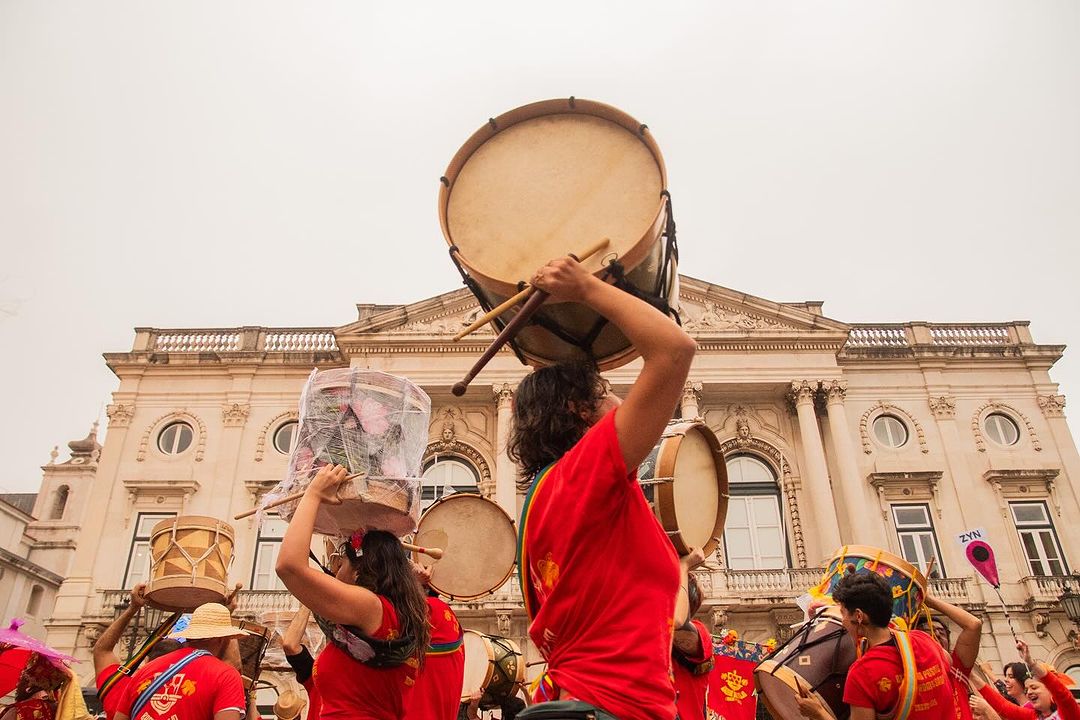
On the Sunday of carnival in 2024, the percussion groups Baque do Tejo and Baque Mulher led hundreds of paraders to the thundering syncopated beats of Northeast Brazilian maracatu, eventually arriving at City Hall (câmara municipal; see Figure 1). The two carnival groups, formed primarily of Brazilian immigrants, then engaged in a mock protest. Knowing that the office was closed, they called out to Mayor Carlos Moedas to formally receive them. The prior Sunday, Moedas had, in fact, received the “royal embassy” of the carnival of Torres Vedras, a city an hour north of Lisbon and home to the self-declared “most Portuguese carnival of Portugal” (Carnaval de Torres Vedras 2013).1 Ringing the bell and knocking on the door, the Brazilian carnival groups of Lisbon asked for a photo with the mayor as he had done for the representatives of a different city’s carnival in Portugal. Expecting no response, they highlighted the differential treatment that Brazilian carnival groups had experienced, juxtaposing the warm welcome for other Portuguese cities’ carnivals with the City’s cold shoulder to that of its own immigrant populations.
Figure 1. Maracatu carnival protest in Lisbon (photo by Nina Bufferli Barbosa, with kind permission, all rights reserved).
In this act of playful protest, the musicians enacted traditional satirical tropes of what Aurélie Godet calls the “politics of carnival” (2020), using the vocabularies and occasion of the famously subversive festivity to mock power.2 Yet the more fundamental question she discusses regarding the politics of carnival, whether the festivity is a practice of resistance or a relatively apolitical festive event – a ludic “safety-valve” with little transformational power – also framed the central issue for both the blocos and the City officials they targeted. The two sides had been debating how the Lisbon’s Brazilian carnival events should be managed: as protest, party, or both?
Around 2015, parades of blocos, or street carnival music ensembles, began to appear in Lisbon’s public spaces to mark the pre-Lenten moment of carnival, which is a national obsession in Brazil, but, despite having its origins in Portugal, is not much of a public celebration in Lisbon. These groups initially paraded under the status of “manifestation” (manifestação), or “demonstration,” based on the right to public assembly. The law guaranteeing the right to demonstration in public space was enshrined months after the 1974 Carnation Revolution ended the dictatorship, which had tightly controlled dissidence.3 Though the term “demonstration” primarily refers to political gatherings and protests, it is also used by religious organizations and other not explicitly political groups. Requiring only notifying the City three days ahead of time, for the blocos, parading as a demonstration was not only the most practical solution, as the costs of holding the parades under this status were minimal. But it also felt true that they were political protests, given the parades’ importance to highlighting the visibility of the immigrant population. As Karlla Tavares, one of the prominent members in the fight for carnival told me, “We are always already political bodies here in European territory. We have a right to the city. We live here, and life is not just about working. We have the right to have fun, too” (interview, March 11, 2025).
But as the crowds the blocos generated grew over a few years from the hundreds to the thousands and tens of thousands, becoming the largest Brazilian-led carnival outside of Brazil, the City’s approach to the parades changed in 2020. The Public Security Police (PSP) began to deny their requests to parade as demonstrations and categorized them as “commercial events” instead.4 This new legal status, equivalent to that given to major corporate festivals, required a variety of costs, including permits, security, insurance, and sanitation, which the blocos were newly forced to cover, despite being non-profit groups that do not charge an entrance fee to revelers. These costs grew increasingly burdensome for the blocos and were one of several bureaucratic obstacles that threatened the viability of Lisbon’s emerging Brazilian carnival. In 2023, they began to engage in a unified campaign demanding a plan for the viability of the festivities, including the protest actions described above. As a result of the campaign’s development over the following two years, Lisbon City Hall ultimately agreed in 2025 to make the carnival an official cultural event of the city, yielding to various demands of the blocos and establishing itself as a partner in the organization of the festivities going forward.
Showing how the carnival groups preceded through what Jonathan Christiansen (2009) calls the “stages” of a social movement, in this article I discuss the blocos’ analysis of their situation and chronicle their organizing efforts to ultimately achieving an agreement with the City. I argue that, despite a general lack of explicitly xenophobic rationales on the part of the City Administration, the blocos consistently encountered structural xenophobia, by which I refer to the systemic obstacles immigrants face in navigating life in the host society. This article shows how immigrant musical groups might successfully dismantle structural xenophobia, highlighting the structural barriers immigrant musicians face even when explicit prejudice may appear absent.
As a US American ethnomusicologist living in Lisbon since 2021 who first studied Rio de Janeiro’s street carnival (Snyder 2022), I have played as a trumpet player with five of Lisbon’s fifteen blocos since the carnival of 2022. In addition to watching this issue play out over the past four carnivals as a participant-observer, I followed the media about the topic and conducted interviews with some of the main actors involved in the campaign. Working as an ally with the carnival groups of which I am part in our common pursuit to establish a stable foundation for the realization of the festivities, I participated in many of the discussions, protests, and events related to the campaign.
Structural Xenophobia and Immigrant Festivities
That xenophobia is a structural element of Brazilians’ lives, rather than only a prejudicial attitude of some of the host society, has been a consistent perspective articulated by interlocutors during my fieldwork. In a broadcast conversation about the blocos’ challenges hosted by the Forum of Brazilian-European Integration (FIBE), City Councilmember Vasco Barata, of the far-left party Bloco de Esquerda (Left Block, hereafter BE), argued, “Structurally, we live in a xenophobic society. Brazilians suffer much more discrimination, for example, in access to housing” (in FIBE 2024). Brazilian immigrant journalist Álvaro Filho, in his column “I don’t speak Brazilian” (“Eu não falo brasileiro”), coined the term buro-xenofobia, combining the terms bureaucracy with xenophobia to describe the ways that bureaucratic obstacles left immigrants in Portugal distinctly disadvantaged. While Portuguese often decry the country’s bureaucratic slowness, what Tavares called “that Portuguese thing of the first answer always being ‘no’” (interview, March 11, 2025), Filho portrays buro-xenofobia as that which
paralyzes and makes invisible the existence of immigrants in the country. Buro-xenofobia is not a process aimed at legalizing immigrants, but rather the opposite. The web of papers, signatures and stamps is an invitation to irregularity, informal work, underemployment, rent without a formal contract, stalls on the sidewalk, and marginalization. It is a laborious process dedicated to transforming the immigrant into the negative image we have of an immigrant. (Filho 2024)
Despite the insights about structural obstacles faced by immigrants, and though other forms of structural exclusion based on race or gender have been extensively studied, structural xenophobia is a relatively undeveloped concept. Zambian legal scholar Tendayi Achiume defines “structural xenophobic discrimination” as “harm to refugees and other foreigners that results from the disparate effects of various measures on these groups even in the absence of explicit prejudice” (2014: 326).5 She argues, however, that prejudiced-based and structural xenophobia are not mutually exclusive and can overlap in practice. Indeed, “acts of explicit prejudice-based xenophobic discrimination occur within the context of pervasive structural xenophobic discrimination” (ibid.: 337). Structural xenophobia can allow institutions to exclude immigrants in ways that might in fact be driven by prejudice, conscious or unconscious, by providing the conditions for policy makers and functionaries to exclude through a cloak of institutional legitimacy or simply unwillingness to use institutions on behalf of immigrant communities’ demands.6
Achiume primarily highlights the practical obstacles of structural xenophobia complicating immigrants’ lives – such as access to housing, status regularization, work permits, etc. Drawing on musical scholars who have built their cultural analyses on frameworks based in legal studies such as Critical Race Theory (Ewell 2020), this article expands on Achiume’s legal framework by discussing structural xenophobia in relation to the management of immigrant festivities. It contributes to studies of music and migration7 by highlighting host society mechanisms of exclusion beyond cases in which prejudicial discrimination is explicitly present.
Indeed, the representatives of Lisbon’s event management systems consistently highlight their equality to access services to realize festive events. In its dialogues with the Brazilian carnival groups, for example, Lisbon justified the decision to categorize the blocos as events by claiming, in the words of the City’s Secretary of Culture, Diogo Moura, that “we cannot favor this event to the detriment of others” (Serafim 2024a). Álvaro Filho (2023) reports that, Moura “emphasizes that he has nothing against Carnival, much less Brazilian Carnival: ‘On the contrary, during my vacation in February, I spent Carnival in Rio de Janeiro. And it wasn’t to see the samba schools,’” the Secretary added, underscoring his interest in the blocos of Rio’s street carnival in particular.
I suggest that event management systems8 often exclude, regardless of their intentions, by not attending to equity; that is, the differing needs faced by immigrant populations and their festivities, which may not match the predominant models of festivity in the host society. Event management systems often privilege local cultural events over others because they were initially designed by local communities to facilitate their events and may not readily adapt to integrating new and foreign cultural practices.9 Yet, mirroring Achiume’s argument that structural discrimination provides a context for prejudicial discrimination, the blocos assert that the decision by the City to apply the status of event to their community-based, non-profit groups was an exploitation of the system that has prejudicial rationales, conscious or unconscious, behind them. In practice, the City does provide exceptions, including direct funding of cultural events that it deems worthy of support, and it has appeared to treat other community-based street parties of Portuguese origin with more lenience and bureaucratic facilitation. The question naturally arose of why and how Brazilian carnival was being treated differently.
Fundamentally, I argue that, until the achievement of the accord in 2025, Lisbon wielded institutional forces in its attempt to manage the carnival in ways that entrenched structural xenophobic discrimination towards the Brazilian immigrant carnival and provided a context for prejudicial discrimination, consciously or unconsciously, to be enacted generally through non-explicit means. As the opening example shows, the decision to categorize the blocos as commercial events rather than political demonstrations ironically only politicized the blocos further, re-entrenching the affect of carnival as subversive and providing the foundation for the carnival to cohere into a social movement against structural xenophobia. As many carnival participants themselves insisted, I assert that how Brazilian carnival is, or is not, incorporated into the city’s cultural fabric reflects a broader question regarding the integration and inclusion of Brazilian immigrants and their sense of belonging in their adopted host country.10
The Rise of Brazilian Carnival in Portugal
Lisbon is the ex-metropole of Brazil and has a unique postcolonial relationship with its ex-colony. In my forthcoming book, Postcolonial Intimacy: Brazilian Music and Carnival in Portugal, I argue that “postcolonial intimacy” pervades the Luso-Brazilian relationship, which is based on a high degree of mutual familiarity arising from the countries’ shared histories and language, as well as demographic and cultural circulations. Brazilian immigrants began to enter Portugal in large numbers following the country’s integration into the European Union (then the EEC) in 1986. They have grown into the largest immigrant population in Portugal over several migratory waves including a diversity of class backgrounds and regional origins, representing 5% of the country’s total population, and 10% of Lisbon approximately. Having invested heavily in tourism as a financial resource following the financial crisis that began in 2008, Portugal has more broadly become increasingly attractive as an immigration destination for communities from the ex-colonies like Brazil and Lusophone Africa, low-income immigrants from non-Lusophone countries, and higher income immigrants (so-called “expats”) (Snyder 2023a). The Brazilian carnival has sought to claim public space in a context encompassing heightened stresses of tourism, gentrification, immigration, and housing speculation. In this context, Portuguese fado has been highlighted as the central music of touristic commodification (Sánchez 2016), even as many other genres, especially Brazilian music and the music of other ex-colonies, also proliferate around the city.
Given the affective context of postcolonial intimacy, Brazilian carnival might seem particularly easy for the Portuguese capital to integrate among the various cultural practices that have come to the city. The carnival tradition had died out in Lisbon and Porto, where carnival celebrations have not since existed until the efforts of Brazilian immigrants. For campaign participant, Karrla Tavares, this history of carnival in Lisbon was “an argument in our favor” (interview, March 11, 2025), since Brazilian immigrants could claim to be reviving the city’s carnival traditions as well as importing new ones. The contemporary carnivals of smaller Portuguese cities that have been maintained are in varying degrees influenced by Brazilian music and carnival traditions. Several smaller Portuguese cities are host to an almost fifty-year Portuguese tradition of recreating samba schools based on Rio de Janeiro’s iconic carnival model. The city of Sesimbra, an hour south of Lisbon, for example, has 50,000 residents and seven samba schools, the members of which are almost entirely Portuguese. Each school mobilizes hundreds of participants in carnival around a theme song (samba-enredo), parading one after another in unified processions modeled on Rio de Janeiro’s sambódrombo (parade stand complex). In many of these cities, Portuguese city governments provide some level of direct funding for the schools to support the tourist economy of the city during carnival (Snyder forthcoming-b).
The hosting of Brazilian-influenced carnivals in Portugal is all the more notable, and perhaps galling, when compared with the treatment of Brazilian immigrants attempting to recreate carnival practices in the capital of Lisbon. As there is no national policy regarding carnival practices – which are rather based on decentralized, city-by-city management – Lisbon’s resistance to facilitating Brazilian carnival cannot be blamed on precedent set by other Portuguese cities that host Brazilian carnival expressions. Nevertheless, when examined from this broader perspective, it appears that the issue has not been the national reference of the festivities, but rather who is celebrating them. In a newspaper article titled, “The Portuguese Hypocrisy,” political scientist Joris Alberdingk Thijm, a Dutch participant in Lisbon’s Brazilian street carnival, notes that “Brazilian culture is consumed strongly in Portugal, so much so that in the carnivals of Sesimbra and Torres Vedras, it is primarily Brazilian music that is heard, but it is oppressed when it is Brazilians themselves who express it” (2024).
The relative difficulties faced by Brazilian immigrants practicing Brazilian musical traditions in the public spaces of Lisbon reveal how structural xenophobia limits the possibilities of postcolonial intimacy for the flourishing of immigrant culture from Portugal’s largest former colony. In an interview, Portuguese anthropologist and member of Baque do Tejo, Miguel Dores, who has been involved in the fight for carnival’s viability, contextualized Lisbon’s resistance within a larger context of cultural threat represented by Brazil, a country with over twenty times the population of Portugal. The influence of Brazilian culture in the world, the impact of the Brazilian accent on European Portuguese, a saturation of Brazilian media products in Portugal, and the popularity of supposedly more sexualized musical practices are all sources of cultural anxiety in Portugal. He mused that, “It is the complex of the dwarf father [pai anão]. Portugal loves to see itself as Brazil’s father, but it is a small father, one who looks at his son and says ‘damn, look how he’s grown’” (interview, June 17, 2024). Carnival, then, represents a fear that “they want to take the city; they’re invading the country.”
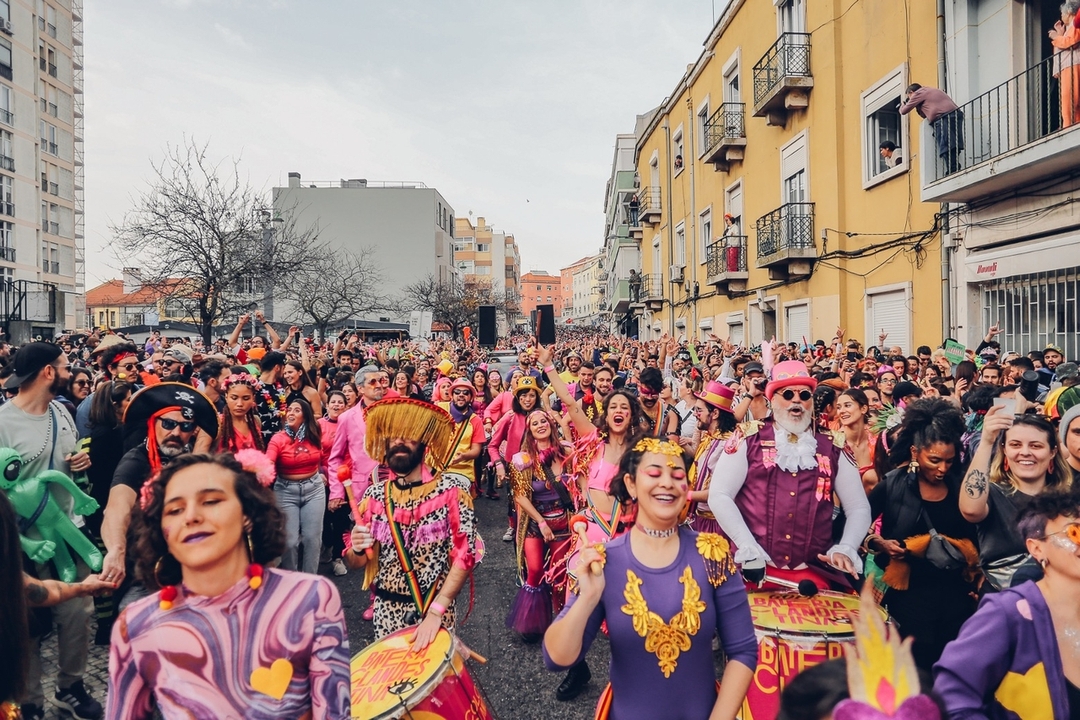
Another element in the controversy has been the distinct forms of Brazilian carnival that Brazilian immigrants and Portuguese celebrate. The Portuguese carnival appropriations are modeled on the samba schools, which were codified and disciplined into organizations in Rio de Janeiro that compete in the controlled spectator space of the sambódromo, with one group parading after another in a relatively orderly spectacle. Since 2015, Brazilian immigrants, on the other hand, have brought a different carnival form known as “street carnival” (carnaval de rua). Street carnival blocos refer to a variety of participatory, musical, mobile parade groups that do not compete with one another (Figure 2). In Rio de Janeiro, the primary carnival reference in Brazil, the term street carnival is contrasted to the more official, commodified, mediatized, and controlled samba schools. Lisbon’s Brazilian street carnival not only imposes itself on Portuguese public space; it often dramatically subverts the postcolonial stereotypes of brasilidade (Brazilianness) in Portuguese society by departing from what many Portuguese believe Brazilian carnival to be.
Figure 2. Colombina Clandestina in Lisbon street carnival of 2023 (photo by Raquel Pimentel, with kind permission, all rights reserved).
In Rio de Janeiro, street carnival blocos suffered a decline during Brazil’s military dictatorship and its controls on public gatherings (1964–1985). What is often called their “revival” was initially associated with the country’s reestablishment as a constitutional democracy and re-democratization, leading to an exponential growth and diversification of blocos. The street carnival now regularly features more than 500 blocos, the largest of which can attract up to two million people. A political impulse was associated with the blocos since their historic enthusiasm for re-democratization, but, as Brazil’s politics became more volatile and polarized during the 2010s culminating in the election of Jair Bolsonaro, the street carnival increasingly became a space for activist projects, messages, and interventions, criticizing the country’s rightwing and authoritarian turn (Snyder 2022). Rio de Janeiro’s model of street carnival, including that of an activist street carnival, was reproduced in other Brazilian cities beginning in the 2010s. The appearance of a street carnival of fifteen or so diverse, and to varying degrees politicized, blocos in Lisbon since around 2015 is a continuation of this diffusion of Rio’s street carnival model.11
In Rio, street carnival is extremely musically eclectic; many of the street carnival participants critique the samba schools for their musical homogeneity (Snyder 2022). Following this eclectic aesthetic, Lisbon’s street carnival may not have a samba school, but it has two groups devoted to the Afro-Brazilian percussion tradition of maracatu from the Brazilian northeast and one devoted to the northeastern dance music forró. There are several blocos based on samba percussion, but these generally play a much wider variety of music, from Brazilian regional genres to pop genres and rock. Some are devoted to large ensembles playing a particular instrument, such as the pandeirobloco that features the Brazilian tambourine, or the pífanobloco, which plays the drum and fife music of Brazil. Others have no live music and are mobilized by DJs. Many of Lisbon’s blocos are committed to framing carnival as an intrinsically political celebration and highlight their activism. Colombina Clandestina, for example, is adamantly feminist and gender-queer, organizing itself around three conceptual pillars of “feminism, diversity, and public space” (Snyder forthcoming-a).12 Some of the groups regularly play in protest parades to animate the various social movements they support.
Rather than participating in a singular parade that features all the groups in succession like the samba schools, blocos parade at different times and locations in the weeks preceding and culminating in carnival. As in Rio, they are often associated with particular neighborhoods and are singular events that do not generally interact with those of other blocos, making each one a separate question of management. The structural difference between street carnival and the more familiar model in Portugal based on the formalized samba schools became a central source of conflict between the City and the street carnival, as the City has often pressured the blocos to centralize the groups around a single parade.
The carnival participants who have witnessed the festivity emerge since 2015 describe the early days of relatively spontaneous gatherings without much structure or formalization. Taking advantage of the right to parade as a demonstration, the older blocos Baque do Tejo and Colombina Clandestina began bringing participants to the streets numbering in the low hundreds. Other blocos followed, and the numbers of participants in each quickly grew. By 2020, Dores recounted, “The size of the parades suddenly shocked the authorities, and they started to think that they needed to formalize what was happening” (interview, June 17, 2024). The Public Security Police, a police unit responsible not to Lisbon but the national government, began advising the City soon before carnival that these were more appropriately categorized as “events,” resulting in last-minute disruptions during carnival. Some groups submitted to fees while others were unable to pay and faced fines (Serafim 2024a). The PSP violently attacked a carnival group accused of disturbing public space, resulting in the hospitalization of two Brazilian women (Henriques 2020).
The conflict was put on hold by the COVID-19 pandemic as Lisbon’s carnival went online in 2021. In 2022, the sparsely attended festivities were somewhat tolerated and spontaneously organized as some of the first post-vaccine events to occur. The carnival of 2023, however, emerged as the largest ever. Some smaller groups sought to parade without requesting authorization, but other blocos submitted to the costs, as they required the guarantee of non-interference to safely hold events. According to reporting by Brazilian media outlet Globo, which has closely followed the emigrant population in Lisbon, a series of payments were required, including event permits, noise permits, insurance, police, and porta-potties. Seven blocos paid 9,000€ in total to the security police, of which Colombina Clandestina, as the largest bloco, paid, 2,300€, while the City exempted 1,200€ in taxes on these fees after negotiation (Romeu 2023). City officials argued that the change of status from political protest to commercial event was due to the carnival’s success and the heightened costs associated with large crowds occupying public space. Diogo Moura defended the change by recounting that “today we are talking about six days of activities in various parts of the city, with stages, tents, and parades” (Serafim 2024a). But the costs had come to feel so burdensome as to inhibit the immigrant musicians’ activities and called into question the on-going viability of the events.
The Blocos’ Analysis
The change from demonstration to event was the match strike in launching what Jonathan Christiansen calls the “life cycle” of a social movement for the carnival community (2009: 1). A social movement refers to a group of people “involved in conflictual relations with clearly identified opponents,” “linked by dense informal networks,” and “shar[ing] a distinct collective identity” (della Porta and Diani 2006: 20). Elsewhere I have defined “musical social movements” as musical communities that come “to articulate themselves as social movements” (Snyder 2022: 14) – a process that took shape at this moment in Lisbon’s carnival.13 Christiansen (2009) divides the life cycle of social movements into four stages of emergence, coalescence, institutionalization, and decline, and I will show in the rest of this article how Lisbon’s carnival community followed this cycle. He argues that social movements first emerge in response to widespread dissatisfaction prior to coordinated organizing to rectify the situation. Such complaints proliferated in Lisbon in the years following the change in categorization of the festivities to commercial events.
Following the 2023 carnival and its many challenges with the City, the blocos entered the second stage of “organized and strategic” coalescence, a process of coordinated consolidation and articulation of demands (ibid.: 9). The blocos, which had previously acted in many ways as separate entities, began to band together in search of a solution, engaging in collective analysis behind the scenes that resulted in the eventual articulation of how structural xenophobia manifested in rendering the street carnival precarious. These discussions ultimately generated a movement “frame,” that is, “the signifying work or meaning construction engaged in by movement adherents . . . and other actors . . . relevant to the interests of movements and the challenges they mount in pursuit of those interests” (Snow 2013). This process was detailed in my interviews with representatives of Lisbon’s Union of the Blocos of the Street Carnival of Lisbon formed in 2023 (hereafter UBC, represented by Vice President Karlla Tavares and UBC organizers Miguel Dores and Nei Barbosa), as well as in two public events: a broadcast discussion on the eve of the 2024 carnival hosted by Lisbon’s Forum of Brazilian-European Integration (FIBE 2024) and a round table hosted on the eve of the 2025 carnival titled “Carnival Also Lives Here” (“O Carnaval Também Mora Aqui,” hereafter CTMA 2025). Both events included those involved in organizing the street carnival as well as far-left (BE) local politicians who supported their cause.
The blocos had come to understand that the City was decidedly skeptical of their claim to the status of demonstration given their lack of connection to a political party. But if Lisbon refused the blocos’ claim to demonstration, they asked why a City Hall that has bought into a neoliberal logic of commodifying the city for tourist consumption would treat the emerging carnival with repression and neglect rather than with an eye to profiting from the events. As Dores proffered, “these international elites are expecting a cosmopolitan city, a ludic city with diverse entertainment for many niches, and it would make complete sense for carnival to enter into this logic” (interview, June 17, 2024). February is a period when a city that has been remade for tourism lacks tourists because of the cold, and they persistently noted the elevated tourism that had emerged during the period of Brazilian immigrants coming from around Europe who, rather than miss carnival or make the much longer trip to Brazil, had begun to come to Lisbon.
The City practiced a different neoliberal management, however, in arguing to the blocos that the primary way to resolve the disputes and pay the required fees was to look for commercial support. Some blocos, especially those made up by professional musicians, are in fact eager to benefit from the possibilities of the market. But, for Colombina Clandestina, such commercialization would constitute the gentrification of public space and would be an abnegation of one of its central pillars of public space (Viver a Rua), as the group’s leader Andréa Freire explains: “The bodies that we are bringing into the streets are those of immigrants, Brazilians, LGBTQIA+, and the group’s values are committed to creating non-commercial spaces of inclusion” (in FIBE 2024). For BE City Councilwoman Beatriz Gomes Dias, the City’s priorities were divorced from the cultural needs of its diverse populations, as Lisbon “is increasingly channeling its resources into large commercial events, but that revenue could promote democratic participation in society . . . We want redistribution! Conditions must be created so that the greatest number of people can promote in public space the cultural expressions that represent the diversity of people living in the city” (at CTMA 2025).
Even for blocos who do want to embrace commercial sponsorship, however, the process of garnering such funds can be difficult. Freire recounted how in previous years, the group’s permit to parade was released on the Friday of carnival, a single day before the parade. “How are you going to go about getting sponsorship,” she asked, “if you can’t confirm where and when you are going to parade. Are you actually going to have carnival? . . . It’s not as linear as it is framed” (in FIBE 2024). In other words, for commercial enterprises to support the blocos, they must have a good faith partner in the City Management, what local politician Maicon Santos called the “security of the institutional system. Without prior authorization from the City, no private agency will invest their money” (at CTMA 2025). Furthermore, leaving the blocos in limbo until the last minute regarding parading permits prevented them from parading as demonstrations, which requires three days of public warning. Freire viewed the pattern of leaving permission to the last minute as a deliberate attempt to discourage them from publicizing a unified schedule of activities and even parading at all, using ostensibly neutral bureaucracies to repress the blocos’ activities.
Yet Lisbon is no stranger to street parties, such as the traditional Portuguese festivities celebrating the Santos Populares (Popular Saints), which occur during the entire month of June. In the first half of the month leading to the celebration of Saint Anthony (June 13), almost every neighborhood sets up the infrastructure to host a stationary street party (arraial), involving open alcoholic consumption en masse with crowds dwarfing those drawn by the blocos. If complaints arising from Brazilian carnival focus on chaos and trash, the blocos argue, it is in part because the City has not met the sanitation demands it regularly meets for other such events, worsening the problems and re-entrenching the sense that the blocos are the cause of exceptionally dangerous chaos. This structural failure reinforces prejudicial xenophobic discrimination, recalling Filho’s argument that buro-xenofobia turns the immigrant into the threat they are already imagined to be. As Freire commented, “when it goes badly, the City says ‘look at what Brazilian carnival caused. It’s the fault of the Brazilians’” (in FIBE 2024). Tavares argued that, by contrast, what they wanted from the City was a partner in organization: “If there’s a hospital or a daycare, we can talk go down another street, no problem” (interview, March 11, 2025).
If “where there is a will, there is a way” to manage street parties in Lisbon, one could reasonably ask, why was there no will for Brazilian carnival? “This is behavior that cannot be explained by economic morals,” Dores answered, “but by the economy of morals. That is, the question is where can we morally place our resources” (interview, June 17, 2024). Brazilian street carnival, he argued, had instigated what he called a “moral panic,” a mass perception of threat to the moral fabric of society (Monod 2017). The media focused on trash, alcohol consumption, urine in the streets, and the complaints of residents, resulting in an “alarmist narrative of chaos.” BE City Councilwoman Dias highlighted the xenophobic discourse that “immigrants have to respect ‘our European values’” (at CTMA 2025). In other words, even though the City representatives largely did not use such language, the encroaching anti-immigrant atmosphere in Europe forms the context for the structural exclusions manifested in event management. Dores reflects that:
Politically, we are in a time when the issue of taxes is politicized . . . by a kind of taxpayer supremacy that wants to dictate the morality that immigrants cannot use our resources to carry out their cultural activities . . . Taxes belong to the national community and are meant to protect things belonging to the national community . . . But Brazilian immigrants don't pay taxes in Brazil; they pay taxes here. This is where their cultural rights must be enshrined, not in Brazil. (Interview, June 17, 2024)
Thus, the Portuguese celebration Santos Populares, though creating much more chaos, does not become politically salient because it is a local manifestation of the supposed public interest. What Dores suspected was the City’s implicit view that Brazilians did not have the right to the same support as local cultural practices was expressed in City Hall’s argument to look for support “from your embassy,” which for him represented, “the externalization and nationalization of the practice rather than the integration of it” (ibid.). For Maicon Santos, the structural exclusion could not be divorced from the prejudicial, if implicit, views of politicians: “The major difficulties we are discussing are also closely linked to the profile of the people we elect to govern us . . . If they have a more conservative profile and do not want a more open democracy, naturally there will be obstacles and bureaucratic challenges” (at CTMA 2025). That is to say, the carnival participants understood that structural xenophobia was supported by a latent, if implicit, prejudicial xenophobia.
As debates advanced on how to confront the City’s behavior, a strategy emerged of calling attention to the participation of Portuguese and other nationalities in the blocos, of which there are indeed many, such as myself. Colombina, highlighting its feminism, began to publicly point out that among the women who participated in the group, ten nationalities were represented. Despite street carnival having its origins in Brazil, Freire argued that “it cannot be considered a Brazilian carnival,” but one that was born from the cultural fabric of Alfama, the historic central neighborhood of Lisbon (at CMTA 2025).
A central challenge in dialogue was that the decentralized and mobile form of Brazilian street carnival did not fit into a preexisting model in Lisbon. The City argued many times that the blocos should parade all together one after another as is done in the sambódromo and other Portuguese carnivals of Brazilian influence. In the street carnival tradition, however, as Tavares explained, “blocos maintain their identity and history with the neighborhood. We never wanted to accept going to the periphery because then there ends up being no access to the events” (interview, March 11, 2025). City Councilwoman Dias argued, “It is not up to the City to determine how cultural expression should be carried out . . . The City should seek to understand these differences and find ways to support them” (at CTMA 2025).
The blocos compared their carnival with other models and event management patterns to look for paths forward, including Rio’s own street carnival, Portuguese community festivities, and the for-profit festivals in the category of which they were being put in by being categorized as “events.” Nei Barbosa, who had lived in Lisbon since 2020, recounted his own experience having founded Rio’s Bloco do Barbas the year the dictatorship fell in 1985 and framed Rio’s contemporary street carnival as an expression of political re-democratization. As founder of Rio’s Sebastiana, a league (liga) of blocos through which they could dialogue with the City Administration, Barbosa spoke of the need for Lisbon’s blocos to similarly present a united front, because space for Rio’s street carnival could had never been won without political contestation. He spoke of the immense financial return that carnival represents in Rio de Janeiro, but the Brazilian city was also viewed as a cautionary tale, since its path of commercialization has advanced considerably in the past two decades, making the blocos dependent on sources many of them ideologically reject (in FIBE 2024).
The discussants pointed out various elements of the differential treatment towards Lisbon’s Brazilian carnival in comparison to other events, such as the City’s argument that the use of stages required categorization as events, while many protests regularly use stages featuring music and dance while maintaining the status of demonstrations. The discussants categorically rejected putting the blocos in the same category as major for-profit festivals that charge admission, for which the only eligible benefit is exemption from taxes. Santos Populares returned repeatedly in their conversation as a model to which to aspire. Freire noted that Santos is a democratic occasion in which many communities and associations set up smaller street parties in public space and generate income for local communities, recounting the local partnerships of her Brazilian bloco with Portuguese associations and community members, who regularly sell food and drink at their events.
Yet, these festive similarities with Santos only highlighted the differential treatment towards immigrant festivities. While the blocos were not permitted to engage in commerce like selling beer, which is supposedly only allowed to licensed sponsors, in Santos, it was noted, communities informally sell food and drink without obstacles (in FIBE 2024). As Filho (2023) reported in A Mensagem, Santos benefits from direct financial support unavailable to the blocos. Freire reflected, “At other popular events you don’t see the type of infrastructure that is asked of us, and there are more costs and requirements every year” (in FIBE 2024). Maicon Santos argued, “The law is the law, it’s true, but the way a law is applied to some and others in Lisbon is almost obscene” (at CTMA 2025).
Indeed, it became difficult not to view the double standards in treatment as fundamentally exclusionary, with structural xenophobia becoming merely a pretext for prejudicial xenophobia, as the City used the structural levers of bureaucracy and event management to exclude the immigrant festivity in ways that were, in City Councilman Vasco Barata’s words, “constantly against new cultural manifestations” (in FIBE 2024). Broad agreement emerged among the blocos that it was the City’s responsibility to support community-based, non-profit festive practices with the infrastructure required to make the events safe, sanitary, and viable. As Tavares recounted, the City had to understand that “There is no turning back from this; it will only grow” (interview, March 11, 2025).
The Blocos’ Campaign
Armed with this movement frame, the blocos entered the third social movement stage of institutionalization (Christiansen 2009), whereby they entered the public eye as an institutionalized entity and articulated formal demands. This involved petitions, negotiations, protests, coordination with a range of institutions and consolidating the blocos into a unified voice. The blocos recognized that a series of negotiations with City Hall by individual bloco fragmented their efforts. Inspired by the model of bloco leagues (ligas) in Rio de Janeiro and advised by Nei Barbosa who had created Rio’s first, they founded the Union of the Blocos of the Street Carnival of Lisbon (União dos blocos do carnaval de rua de Lisboa).
Through this body, they began to engage in bi-weekly dialogues with the City, confronting a general unwillingness of the Lisbon’s representatives to let go of a predefined carnival model of a unified parade occurring on a single day. Increasingly silly requests were made by the City, such as the requirement for the bloco Sardinhas Nômades, which parades on the public walkway lining the Tagus River, to bring along a lifeboat in case anyone fell into the river (this being the Cais do Sodré, an area with numerous night clubs with parties regularly lasting until dawn). Confusion reigned as the PSP claimed City Hall had categorized the carnival as an event, with the City arguing they had no power over the PSP’s decisions; as Dores recounted, “It’s everyone’s and no one’s fault” (interview, June 17, 2024).
In coordination with their negotiations, they organized a petition, signed by the participants, most of the blocos, and the anti-racist and pro-immigrant organizations SOS Racismo and Casa do Brasil (Miranda 2023). They demanded the “de-bureaucratization” of street carnival, and the petition pointedly claims that “street carnival is a cultural and political demonstration, and not an event! Carnival is a happening in which socio-political criticisms are articulated and gain great visibility through music, dance, costumes and collective mobilization . . . Street carnivals . . . are a historic mode of claiming right to the city, to voice, to culture and to existence itself” (Baque do Tejo et al. 2023). They rejected the City’s logic of event categorization, a change from demonstration which, the petition recounts, was never explained or justified by the City. They point out that these non-profit blocos contribute to the local economy, arguing that their rights to public assembly, guaranteed by Portuguese democracy, are being infringed. The City was making the events “unviable,” and they demand a solution, using a line that dated to Colombina’s first parade and became a motto of the movement: “Carnival doesn’t ask for permission; it demands passage” (ibid.).
The petition eventually resulted in a meeting with the Municipal Assembly on January 11, 2024, where they presented their case to council members. In the minutes of the meeting (Assembleia Municipal de Lisboa 2024), the general lack of awareness of street carnival’s distinction from the more common model in Portugal of the samba schools is palpable. No council members are recorded using xenophobic language, claiming to support the idea of a Brazilian carnival in Lisbon; a member of the far-right party Chega, Bruno Mascarehnhas, even suggested, drawing on a reactionary defense of postcolonial intimacy, that the multicultural argument of the blocos “made no sense since we all share the same culture” (ibid.). Despite the various political causes and initiatives of the blocos, some of which had been publicly praised by the City, the members generally aligned with the PSP and its supposedly incontrovertible authority that carnival was a commercial event and not a demonstration.
Other actions accompanied the petition, including establishing transnational diplomatic dialogues and partnerships with the Brazilian Ministry of Culture, Casa do Brasil, FIBE, and the Brazilian embassy. In August 2023, Brazilian President Lula’s new Minister of Culture and star of the popular carnival music genre axé, Margaret Menezes, participated in a discussion held at Lisbon’s Casa do Brasil, an activist immigrant rights organization that supported the petition. She noted Lula’s past efforts at using state finances to support diverse musical practices in Brazil when tropicália star Gilberto Gil was his Minister of Culture. She adopted assistance for immigrant musical cultures abroad as an extension of this decentralized cultural diplomacy of supporting culture beyond the biggest cities of Rio de Janeiro and São Paulo, recounting “there are a lot of people outside of Brazil doing a lot for Brazilian culture, and the governments never did anything” (cited in Rodrigues 2023). She promised to help mediate dialogue between representatives of the blocos and other Brazilian cultural workers in Lisbon. Using a language of postcolonial intimacy in her citation of Portugal’s status as Brazil’s “brother country” as an appeal to collaboration, she challenged the Portuguese to facilitate the occurrence of “this great carnival that Brazil offers to the world. . . here in Portugal as well” (cited in Lusa 2023).14
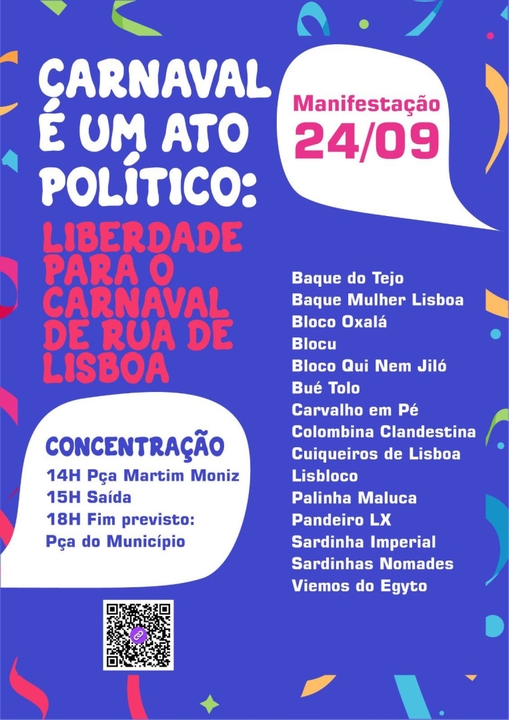
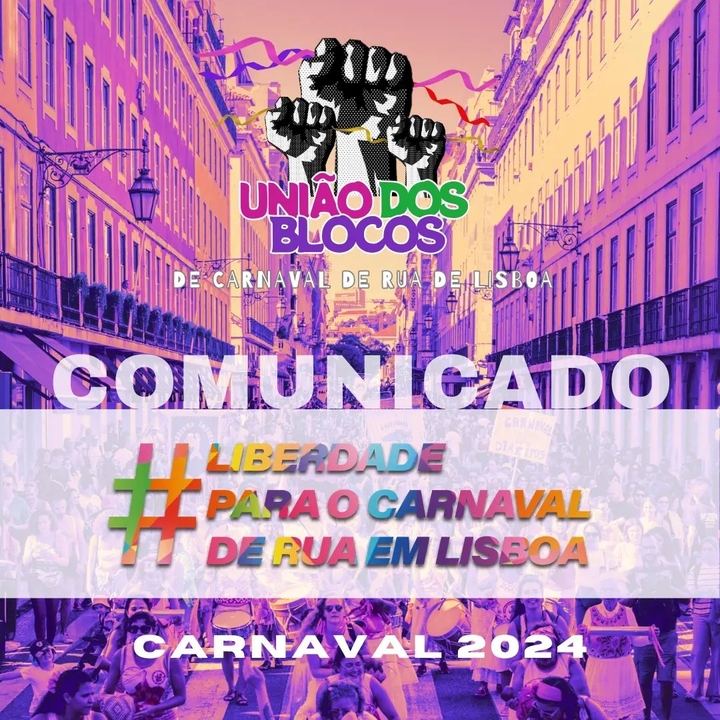
Alongside these institutional and diplomatic channels of dialogue, the Union used the status of a political demonstration to hold a true political protest on behalf of the blocos’ cause, which they called “Carnival is a Political Act – Freedom for the Street Carnival of Lisbon” (Figure 3). I have shown elsewhere how street carnival blocos in Rio have used their musical and organizational practices to support protests (Snyder 2022), and Lisbon’s blocos drew on this experience from Brazil in convoking a protest in Lisbon. They encouraged street carnival participants to flood social media and put up posters around the city. Andréa Freire wrote to Colombina participants, quoting the famed 1968 protest song of Caetano Veloso, “IT’S PROHIBITED TO PROHIBIT! [É PROIBIDO PROIBIR!]. We exist as a community and demand a collective right to THE STREET! . . . without the street, carnival is silenced and coerced” (Freire, WhatsApp message, September 20, 2023).
Figure 3. Protest advertisement created by the Union of the Blocos (with kind permission, all rights reserved).
Held on September 24, 2023, eleven blocos paraded with an estimated 3,000 people through the city (Romeu 2023; Carrilho 2023). We began in Martim Moniz square, an area associated with diverse immigrant communities, and would snake through to the city center, moving from the immigrant margins to the center of Lisbon. The protest would be an “out-of-season carnival” (“carnaval fora de época,” Filho 2023). We constructed signs communicating the demands, such as one that quoted the line of a song by Brazilian band Los Hermanos, “Every carnival has its end,” with “end” scratched out and replaced with “rights.” The parade would be led by a sound car from which a Union representative explained the situation and punctuated the music with short speeches. Seeking to “de-nationalize the practice,” as Dores had suggested (interview, June 17, 2024), the representative publicly argued that the event was crucial for the Brazilian community but that “carnival belongs to the entire world.” They led rhyming chants written for the occasion including, “Carnival is annual, and this demonstration is cultural” (“O carnaval é anual, e o manifesto é cultural”), “My carnival is free and doesn’t need to pay fees” (“O meu carnaval é de graça e não precisa pagar taxas”), “In Brazil or in Portugal, I have the right to celebrate carnival” (“No Brasil ou em Portugal, tenho direito a brincar o meu carnaval”).
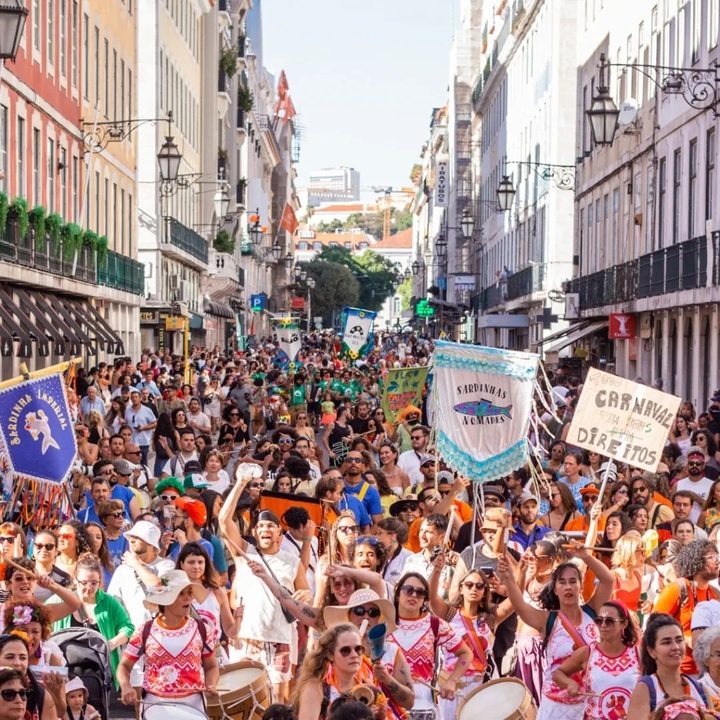
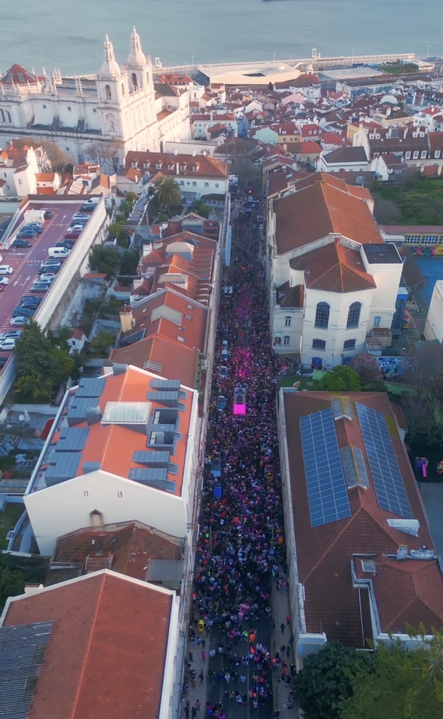
To prevent sound bleeding between blocos, the Union assigned each group a number in order of position by which they were requested to play at the same time, alternating between odd and even numbers. The maracatu groups, the rhythms of which are highly syncopated with bass drum hits often a sixteenth-note off the pulse, were to play together and not with the samba-based groups, which maintain a more consistent on-the-beat bass drum pulse, though these attempts to maintain musical distinctions quickly fell apart. The softer northeastern regional music of forró blended with samba percussion, quiet pífano flutes, and booming Afro-Brazilian maracatu rhythms. When the parade entered tight streets, the simultaneous diversity echoing off the buildings provided a sonic metaphor of the “audible entanglements” (Guilbault 2005) of a street carnival produced by immigrants from all around Brazil. It was quite distinct from the generic homogeneity of samba school parades, which, aside from featuring the same basic rhythm, isolate one group from another. The chaotic soundscape highlighted the impracticality of the City’s suggestion for a unified parade (Figure 4).
Figure 4. Photo of protest by Raquel Pimentel featured on Globo’s article (Romeu 2023; with kind permission, all rights reserved).
As I accompanied this protest into the central streets of Lisbon’s Baixa, I noticed that, in the many public spaces in which I had attended bloco events, they had never been in the central downtown of the city. On this occasion, however, we paraded through areas and major streets that are used by Portuguese cultural events, such as the Marchas Populares (Popular Marches) of Santos Populares, but that have never been given to the Brazilian blocos. These are highly visited areas where startled tourists stared on in amazement and confusion, avidly taking photographs. When we reached these areas in this symbolic disruption of the hegemonic cultural order, the representative of the protest switched to English, explaining the situation and asking the tourists to “join us.” The protest ended at a square where each bloco representative spoke of the significance of the protest and its demands on behalf of the immigrant community, including the claim of one bloco that supporting Brazilian carnival was a responsibility of Portugal to pay historical reparations. That the Brazilian carnival was marching from the cartographical margins of the city to its center felt like an inexorable march towards resolution to the problems, indicative of the movement of Brazilian immigrants to the center of Portuguese cultural life and the eventual elimination of structural xenophobia towards the carnival.
Yet this sense of optimism would clearly be misplaced, as Lisbon subsequently advised the blocos that instead of protesting they should have been looking for financial support, and the act seemed to have turned the City further against the blocos. Despite maintaining communication and dialogue with the City into the winter, by only a couple of weeks before carnival was to begin in February 2024, no resolution to the situation had been reached. It was reported that the 12 groups would be charged 26,000€ to hold their events, a number that would grow closer to 30,000€, significantly higher than in 2023 despite the negotiations (Serafim 2024b). The Brazilian Embassy gave 5,000€ to the celebration as part of its practice in supporting artists outside of Brazil, but this would not come close to covering the costs (Amato 2024). The BE pushed an emergency vote in the City Council to support the event, which no other party supported. With national elections scheduled for the following month and the far right and its anti-immigration message growing, Dores suggested that no party wanted to stick its neck out for Brazilian carnival. And then, he told me, “suddenly the City stopped responding to anything” (interview, June 17, 2024).
Carnival Amidst Uncertainty
With the impasse unresolved and carnival fast approaching, the blocos, many of which had been practicing all year, entered a collective freak out about whether they would be able to hold their events at all. As I was planning to play trumpet with four of these groups, I was privy to a series of exhaustive WhatsApp discussions of what to do. The level of legal literacy that some members had gained through the process of negotiation – understanding exactly what rights and punishments attended the various statuses of demonstration, event, and illegal parade – was impressive. With no resolution, during the carnival of 2024, their campaign would continue, making carnival a politicized venue for the articulation of the demand for its very viability.
The pandeiro bloco was the first bloco scheduled to parade the week before carnival and therefore the least prepared to know how to respond. The bloco was met with a 1000€ bill, including 600€ to close off the streets, 100€ for insurance of material patrimony, and personal insurance of 300€ for the 300 expected audience members (1€ per attendee). When the blocos attempted to inquire about obtaining this personal insurance, Dores recounted (ibid.), the insurers themselves were bewildered by the request since this would require taking the name of each insured person. The bloco decided to parade only through the tight pedestrian alleyways of the historic Alfama neighborhood rather than take over public streets, significantly shortening their original route and preventing much of the public from the seeing the event.
It did not go unnoticed that the City had simultaneously allowed a neo-Nazi, anti-immigrant protest to go forward at the same time, since it was clearly a political demonstration (Lima 2024). In other words, the structurally xenophobic policies as interpreted and executed by the City criminalized a relatively small innocuous parade, while allowing the free expression of a group that threatens the fabric of Portugal’s multicultural democracy. Furthermore, as noted in the beginning of the article, the next morning the City also reenacted the annual ritual of receiving a sponsored visit from the carnival groups of the Portuguese city Torres Vedras, home to the self-declared “most Portuguese carnival of Portugal.” On the occasion, Mayor Carlos Moedas argued that “carnival is a symbol of freedom, of that which we all want to be” (Câmara Municipal de Lisboa 2024). The relative marginality of Lisbon’s own immigrant carnival felt palpable.
By the time Wednesday before carnival weekend arrived, the three days necessary to inform the City of a demonstration, still no resolution had been reached. Dores recounted that “the City didn’t even have the budgets ready [even if we had been able to pay] because in one case they thought it wouldn’t happen and in another because they never received the necessary documentation from another office” (interview, June 17, 2024). The City had engaged, he argued, in a “boycott of the process” (ibid.). All the blocos except one, which secured the support of a local neighborhood government, canceled their official events and declared that they would parade officially as demonstrations after all, whether or not they were accepted as such by the City (Serafim 2024b).
The Union prepared a political statement that repeated its central arguments to be released and adapted by the blocos, which would make carnival into a “protest against gentrification of public space and for culture in the streets” (União dos Blocos 2024; see also Figure 5). If the right to protest were denied, the Union would cover the possible fines through crowdfunding and benefit concerts. Colombina published screenshots of unreplied emails to the City on Instagram and other communication, showing, for example, that the 2,400€ paid in 2023 had risen to a bill of 3,800€ the year after for a much shorter trajectory:
Colombina declares that, due to the lack of responsibility and support and the bad management of the process on the part of the city, which in seven months of meetings did not manage to give clear responses even a single day before the event, constantly requiring new unlisted demands with huge costs, Colombina will demonstrate in the streets for the right to occupy public space and for the defense of immigrant culture in Lisbon. (Colombina Clandestina 2024)
Figure 5. The Union of the Bloco’s Instagram image for statement on the 2024 carnival (União dos Blocos 2024; with kind permission, all rights reserved).
The 2024 carnival, by and large, occurred. But all the infrastructures the City demanded to create a more orderly event were absent. For many of the blocos, parading legally or illegally made little difference, as their mobile, acoustic formation was not obstructed. Yet, there was a significant reduction of participants in comparison to the year before, with some tourists unwilling to come to Lisbon for a carnival that wasn’t clearly going to happen and the politicization of the events perhaps scaring off others. Dores related that the crowds for Baque do Tejo diminished from 3,000 in 2023 to 300 in 2024 (interview, June 17, 2024). The performance of Colombina, which has developed a large infrastructure with a mobile sound car to amplify brass and percussion instruments to be heard by the thousands who would attend, was substantially impacted. While we went ahead with the sound car, we did not risk setting up a stage as we had the year before and planned this year for the stage show. We would instead stop in a different square, and the singers would sing on top of the sound truck, modeled on the trio eléctrico of Salvador, Brazil, while the horns accompanied them from below (Figure 6). We only completed a third of our stage show before being shut down.
Figure 6. A still from a drone video of Colombina’s 2024 carnival parade on Instagram (Colombina Clandestina 2024); with kind permission, all rights reserved).
The performance of many groups was self-consciously politicized both as a response to the City and as a performative justification for the very status of a demonstration. The leader of Lisbloco announced that, “Our performance today will not be our official carnival parade, but rather a political act in favor of public policies for Lisbon’s street culture. It is very important that this act be characterized as a political demonstration with joy and without anger” (Brechó, WhatsApp message, February 13, 2024). The bloco included signs echoing the vocabulary of the campaign, such as “No one takes carnival seriously, except City Hall” (“Carnaval ninguém leva a mal, só a câmara municipal”) and “Fado and samba side by side” (“Fado e samba, lado a lado”), imagining through referencing the potential proximity of the countries’ iconic national genres, a postcolonial intimacy that appeared in that moment not to exist.
Ultimately, by the carnival of 2024, the City’s obstacles ended up providing a unifying force in a carnival scene that has at other times felt fragmented and even territorial, with participants overall focused on their own bloco(s). The experience of collective protest and the Union’s emerging capacity to unify the narratives of the festivity’s importance, meaning, and demands had created a more dynamic scene. The final event before Ash Wednesday, for example, was a carnival dance hosted by the Union called the Union Ball (Baile da União), featuring several of the blocos in succession, punctuated by the Union’s speeches about the City’s exclusion of its activities. A bagpipe (gaita) from northern Portugal played with Bloco Oxalá, a northeast Brazilian samba-reggae group, creating an odd musical hybrid that symbolized the possibilities for Luso-Brazilian fusions. The night ended in an impromptu performance of unity, in which the outnumbered horns gathered at the center of concentric circles surrounded by all the percussion of the other groups to play through sambas, forrós and carnival marches, culminating in a unified percussive bang.
After all the media coverage as well as the allowance of neo-Nazi protest the weekend before, Dores mused that it would not have been a good look for the City to actively repress a carnival representing multiculturality, public access to culture, and queer rights (interview, June 17, 2024). He expressed confidence that, if the City chose to fine the carnival groups, the blocos might win the right to a demonstration in court due to the heightened political character of the events, which they had self-consciously amplified in response to the City’s behavior. Yet, the “cluttering of neither yes nor no” (ibid.) weakened the events, highlighted the exclusion of Brazilians from Portuguese society, and created more aversion towards the carnival on the part of the city residents. It appeared ultimately unclear what lesson the City wanted the carnival groups to learn, since it had declined to enforce its own categorization of the parades as events and punish them for deviating. With the buro-xenophobic structure neither facilitating nor repressing immigrant activities, the best solution was to ask for forgiveness rather than permission, or “demand passage,” as the case may be.
In the summer of 2024, Dores predicted that in 2025 the situation would repeat itself (ibid.). But remaining unofficial and in a constant struggle with the City was obviously not a long-term viable solution, and so negotiations continued. Over the course of 2024, the Union shifted tactics, choosing to negotiate more directly with the Brazilian Embassy and City Hall, rather than adopting the public campaign of the year before. The Union legally formalized itself as an association to directly mediate between various institutional actors, having studied the document of Rio de Janeiro’s Sebastiana to model their own group (Nunes and Cunha 2024). Using the consolidated structure of the Union, they began to participate in monthly events showcasing Brazilian culture (Feiras brasileiras) at a cultural center and holding other events that raised funds for the carnival community. They held a GoFundMe crowdfunding campaign, which, for one reporter, reflected the adoption of a neoliberal logic of self-management, with the blocos “resorting to the pocketbooks of immigrants to get the carnival going. As a result, those who suffer are those who should be the heart of the party . . . Carnival blocos pass on the cost to revelers through collective financing, . . . outsourc[ing] costs” (Batalha 2025). Yet, by November 2024, it did indeed appear that the situation was repeating itself due to the “lack of disposition of the authorities” (Nunes 2024).
Light at the End of the Tunnel
In a surprise to those not directly involved in the negotiations, on February 11, a month before the 2025 carnival, the Union announced that it had reached an accord between the blocos, City Hall, and the Brazilian Embassy that would officialize the carnival and provide firmer footing going forward (Varela and Ratner 2025). This shift might allow the blocos to enter into what Christiansen calls the final stage of the social movement life cycle of decline, or the “end of mass mobilization” (2009: 6) with various possible outcomes, including success, failure, or repression, among other possibilities. The exciting news of an accord with the City signaled the possibility of this social movement’s success, resulting in permanent changes that might let carnival go mainstream and leave the struggle for its very existence behind.
The accord signaled that the City would relinquish its categorization of the blocos as events and associated costs to use public space, categorizing carnival as neither a political demonstration nor commercial event but as an “official event of manifest cultural interest,” or a “cultural demonstration” promoted by the City (manifestação cultural, not of the same category as manifestação política). Freire explained this designation as having many of the elements of a commercial event in terms of management of public festivities, but City Hall would share the brunt of the costs and facilitation since the events would now be deemed of import to the public (personal communication, March 12, 2025). The City would become a “co-organizer” of the events, and carnival would enter into Lisbon’s official cultural calendar as cultural patrimony of the City, aside host society events like Santos Populares (EGEAC n.d.). The City would commit itself to taking care of sanitation, cleaning, organizing the events, and issuing permits, and it would mediate between the blocos and other institutions and agents, publicize events, and assist the groups in applying for cultural grants. The blocos would still have to bear the brunt of the costs to the PSP, run by the Portuguese Government and not the City, though the Embassy promised to aid the negotiations with the PSP. The blocos would not receive direct financing from the City, which many had argued was vital. For Tavares, however, recognition had to come first: “As street carnival is both a political and cultural mobilization, ensuring that it was recognized by institutional bodies as a ‘Cultural Manifestation’” was what she viewed as the first step (interview, March 11, 2025).
The news generated great excitement, even more so when it was announced that the agreement would be signed in Brasília during the Luso-Brazilian Summit between Portuguese Prime Minister Montenegro and Brazilian President Lula da Silva on February 19, pointing to a major diplomatic victory. Yet the summit came and went without being signed, with the Union receiving no explanation for the change nor information on when the accord might be formalized (Nunes 2025a). The pre-carnival weekend, when the first events were scheduled, arrived without a plan. Again, Pandeiro Lx paraded with no permission, the bloco’s leader nervously leading the musicians to the streets with the hope that the group would not be fined. The next day, Lisbloco’s rehearsal in a public square was shut down by the City Police (Nunes 2025b). At the public roundtable between various actors of the carnival held that weekend, it appeared that no victory was assured with carnival fast approaching the following weekend. Tavares reported there that, “we are in the same place we were before, and we are going to have to celebrate just like we did last year” (at CTMA 2025).
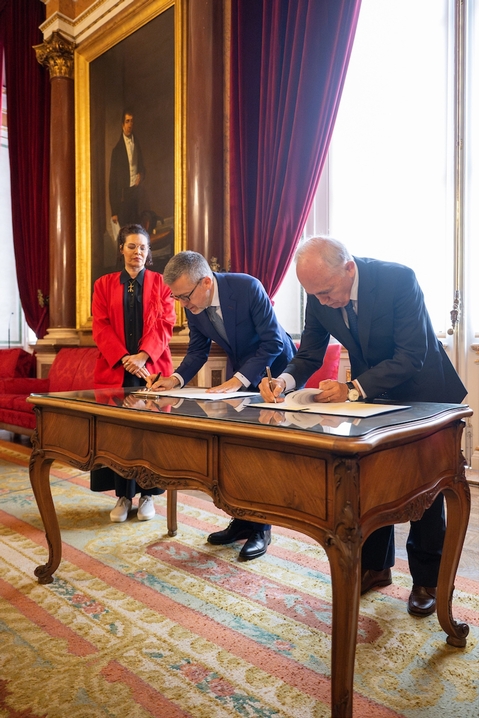
Two days later, however, on Tuesday, February 25, 2025, Tavares appeared to City Hall to witness the signing of the accord of “intention and cooperation” alongside Mayor Moedas and Brazilian Ambassador Raimundo Carreiro (Figure 7). By all reports, the Brazilian Embassy had consistently pushed on the City for the resolution of carnival, not letting it fall by the wayside (Nunes 2025c). Highlighting the postcolonial intimacy between the countries, the partnership foresees a “mutual commitment to promote cultural exchange between Portugal and Brazil . . . and an interest in strengthening the historical and cultural ties that unite the two peoples” (Câmara Municipal de Lisboa and Embaixada da República Federativa do Brasil 2025). The City officially recognized carnival’s cultural and economic potential to contribute to Lisbon, as well as the “intercultural dialogue and transcultural connections,” “strategic vision of cultural offering,” “integration in the cultural programming of the city,” and “strengthening of multicultural coexistence in the city” (ibid.). To the Union’s surprise, the accord would be in effect for only two years, guaranteeing the viability of the carnivals of 2025 and 2026 but potentially leaving the carnival vulnerable to future changes in policy and administration. Yet, the blocos celebrated the news in hopes that, once the accord entered into effect, future renewals would indeed be possible.
Figure 7. Signing of agreement. From left to right: UBC Vice President Tavares, Mayor Moedas, Ambassador Carreiro (photo by Karlla Tavares, with kind permission, all rights reserved).
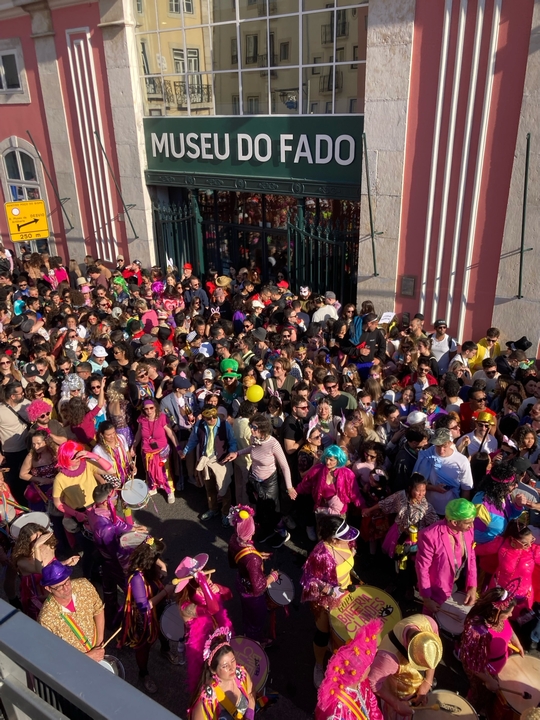
The City had committed itself to being a co-organizer of the festivities, but it had only given itself three days to do so for the 2025 carnival. In protest of the continuing precarity, Lisbloco again paraded as a protest, celebrating the victory but arguing it had come too late to do much good (Nunes 2025d). In effect, many carnival parades rolled unofficially as they had in years past without authorization or organization with the PSP. Yet most did so without fear of fines or being prohibited from celebrating. At the bigger parades, like Colombina, suddenly beer tents, porta-potties and other infrastructure that had been requested by the City at a high price for years was now being provided, and the City shared the event in its own social media (Câmara Municipal de Lisboa 2025). An estimated thirty thousand people gathered around an enormous sound truck at the base of Lisbon’s waterfront in the public square in front of the Museum of Fado, creating a notable juxtaposition of Portuguese and Brazilian music-making, side by side at last (Figure 8). Finally, we were occupying one of Lisbon’s iconic public spaces, this time not as a protest, but as an official city event. We mounted the sound truck, checked our mics, and began to roll.
Figure 8. 2025 Carnival (photo by author).
Conclusions and Lessons Learned
When I interviewed Union member Miguel Dores in the summer of 2024, he expressed that he thought the future of Lisbon’s relationship with Brazilian carnival was “lamentable” because the same conflict over the status of demonstration or event would repeat itself for the foreseeable future. By the following carnival in 2025, however, the picture had changed dramatically. The City agreed to many of the fundamental demands of its largest immigrant population. Rather than the blocos’ capitulating to earlier requests that they confine their activities to a single time and place, the City ultimately approved the decentralized model of Brazilian street carnival, wherein blocos parade throughout the city over several days of festivities. After the carnival of 2025, coming only days after the accord had been signed, the Union participants were optimistically looking forward to 2026 as the year, Tavares dreamed, of the “first real carnival of Lisbon and a new era. Now we will see the Lisbon carnival really be born . . . I think a lot of things will change, a lot of things will improve, and the structure will be good for everyone. It’s happening faster than we imagined” (interview, March 11, 2025). In a period of ever-entrenched anti-immigrant discourses from 2023 to 2025, when the center-right took over the country and the far-right made immense gains, what made such a dramatic turn of events and perspective possible?
I asked this question to several of the people closest to the Union organizing, and no one quite seemed to know the answer. They especially credited the Brazilian Embassy for its involvement, as it appears that the Embassy fully embraced the cause of its immigrant population and used the diplomatic power of Brazil, one of Portugal’s closest international partners, on behalf of the carnival. This pressure had evolved in concert with other diplomatic actors including the Brazilian Ministry of Culture, FIBE, the Casa do Brasil, anti-racist and pro-immigrant civil society institutions, Portuguese politicians, and, of course, the blocos’ Union. The Portuguese and Brazilian media persistently followed the developments, and Tavares argued that “Publicity from these media helped a lot in our process . . . With this coverage, the City became more willing to resolve the issues, because it is part of the political agreements between the two countries, which are very close diplomatically” (interview, March 11, 2025). In other words, postcolonial intimacy provided a foundation for resolution of obstacles created by structural xenophobia. Yet, though the “good faith” (“boa vontade”) of Lisbon City Hall was credited, Barbosa insisted that “nothing was given with a free hand” (interview, March 7, 2025). What he called a “conjunction of political force” (ibid.) of important institutional actors collectively applied diplomatic pressure that resulted in a substantial change of policy for the immigrant population.
Yet, if it was perhaps impossible to transform the situation without these partnerships, the prime mover of the cause were the blocos themselves and the Union that came to represent them. It has been their persistent movement to bring a carnival in their image to the streets of their former metropole and their relentless organizing over a decade. Before arriving at the current agreement, the groups passed through years of marginalization and criminalization of their cultural practices. Without their protests, petitions, attendance of City Hall meetings, and collaboration with other institutions, the blocos would not have made the leap from organizing festivities in perpetual uncertainty to arriving at an accord with the City that seals Brazil’s most major festivity as officially part of the cultural landscape of Lisbon. In Christiansen’s terms, in order to achieve institutionalization as a social movement that could possibly decline due to its success, they had to go through the stages of emergence and coalescence alone.
In alliance with my interlocutors, I have argued that it is impossible to understand the differential treatment towards Brazilian street carnival as the result of prejudicial discrimination alone, nor just of what Barbosa called “growing pains” (ibid.). While some City officials may have been disingenuous when claiming that Brazilian carnival should have a place in Lisbon while not acting to facilitate it, I take many City representatives at their word that they did indeed want to see a Brazilian carnival in Lisbon. After all, Brazilian carnival practices are a central, and perhaps the primary, mode of celebrating carnival around Portugal; they are elements of postcolonial intimacy between the countries. The City’s until recent exclusion of Brazilian carnival when practiced by Brazilian immigrants themselves despite its ostensible interest in it existing was due to an overwhelming context of structural xenophobia. Barbosa argued that the City had to be thoroughly “familiarized” (“sensibilizado”) with Brazilian street carnival (ibid.), accomplished only through the carnival’s transformation into a social movement.
Indeed, foreign models of festivity are often not interpretable by the host society, resulting in confusion over how to manage them, even when there is good faith. The lack of historical relationship of foreign cultural practitioners to City Management can create differential treatment in contrast to that practiced towards those of the host society. A context of prejudicial discrimination can unconsciously, and sometimes consciously, reinforce the mechanisms of bureaucratic neglect and structural discrimination. Yet, if much of this article provides evidence for the existence of structural xenophobia in event management, emblematized by its insistence in treating a not-for-profit festivity as a “commercial event,” the social movement’s success provides inspiring pathways and lessons learned for dismantling such systemic exclusions. The process of unified coalescence around the demand for carnival to exist created a consolidated political discourse and relationships with important institutional partners, providing a basis for successfully negotiating with the City.
The history of carnival around the world is, of course, one of contestation, appropriation, repression, and subversion, always political and cultural, an event and a demonstration (Godet 2020). In an immigrant context, minoritized populations must carve out space within a society that is not necessarily disposed to receive them, nor organizationally prepared to facilitate them. Over these years in Lisbon before its recent success, the Brazilian immigrant carnival participants took comfort in knowing that spaces of belonging for excluded populations, and space for carnival itself, have rarely been won except through exactly the kind of struggle in which they engaged.
For more on the question of carnival’s political power, as well as activist potential, see Bakhtin ([1941] 1984), Stallybrass and White (1986), and DeWaal and Colbertaldo (forthcoming).↩︎
Achiume’s term is an etic term and not one I heard used explicitly by my interlocutors, though I heard quite similar formulations, as Filho’s statements show.↩︎
Structural xenophobia can, but does not necessarily, intersect with the more well-known concept of structural racism. Critical Race Theory illuminates how racialized communities can be structurally disadvantaged, including in ostensibly “color-blind” societies (Crenshaw et al. 1995). Immigrants may often experience intersectional structural discrimination based on both race and immigrant status, but they may also not necessarily be racialized as racial others to the host society. I adopt structural xenophobia as the primary prism of analysis for two reasons: first, it is primarily owing to their status as relative newcomers to Portuguese society that Brazilian carnival participants have experienced exclusion. Unlike racially excluded groups who are not conceived as foreign but also experience discrimination towards their longer standing musical practices (such as Black communities in the USA), it is partially the novelty of Brazilian carnival practices that the Portuguese host society has had difficulty in absorbing and managing. Second, Brazil is a diverse and multiracial society, and many of the bloco participants identify as white and middle-class, while Portugal itself, along with the south of Europe, has at times constituted a racial other in the European imagination (Sousa Santos 2002), making a racial analysis based in European whiteness and Global South racial otherness too simplistic. While many Black and Brown Brazilian carnival participants may also experience racism, it is the immigrant status of the carnival that has been the more salient issue in the City’s management of the festivities.↩︎
For more on music and migration, see Stokes (2020) and Toynbee and Dueck (2011).↩︎
Here I refer to the legal entities responsible for categorizing and regulating events, drawing on Guilbault (2007) who employs Foucault’s notion of governance to understand the management of carnival in Trinidad.↩︎
The negotiation of such structural exclusions in event management might be seen as akin to other institutions, such as academia itself as discussed by Sara Ahmed (2012).↩︎
As such, this article contributes to the study of carnival in diaspora and its role in social inclusion. Most of the work on this subject applies to the spread of primarily Trinidadian carnival forms, most notably to the ex-metropole of the Anglo-Caribbean world in London’s Notting Hill carnival. Founded in 1966 and now the largest street festival in Europe, Notting Hill carnival similarly emerged in a context of structural xenophobia and racism and continues to provoke anxieties about immigration, English identity, and urban chaos (Harris 2018; Guilbault 2007). By contrast, though Brazilian musical practices have often been adopted in foreign societies, often not practiced by Brazilians themselves (Pravaz 2009–2010), to my knowledge Lisbon is the only non-Brazilian city where a large Brazilian immigrant carnival has been consolidated.↩︎
In Critical Brass (2022), I argue that carnival participants drew on theories of carnival as subversive in order to articulate their practices of carnival as activist. Beyond Brazil, carnival has often been a space for activist expressions, including in London’s postcolonial immigrant carnival of Notting Hill (Harris 2018). See Godet (2020) on other subversive and activist expressions of carnival.↩︎
In response to Gustave Le Bon ([1895] 2007) and others who viewed crowds and social movements as irrational mobs, social movement scholars in the 1960s and 1970s tended to downplay the role of culture in order to argue for the “rationality” of social movement actors. Indeed, the “disciplined” left in the twentieth century often disavowed counterculture as an impediment to revolution. Since the “cultural turn” of the 1980s, music, emotion, and culture have been valorized for their roles in social movements, but often in ways that are functionalist and treat music as a “resource” for social movement mobilization (Eyerman and Jamison 1998). This article contributes to growing body of recent “studies examining music’s role in political mobilization” (Drott and Manabe 2025: 4).↩︎
For another case of cultural diplomacy, between Lisbon’s blocos and the Portuguese Prime Minister, see Snyder (2023b).↩︎
References
Achiume, Tendayi. 2014. “Beyond Prejudice: Structural Xenophobic Discrimination Against Refugees.” Georgetown Journal of International Law 45(3): 323–381.
Assembleia Municipal de Lisboa. 2024. Relatório: Petição No. 15/2023 “Carnaval é um ato político – Liberdade para o Caranval de Rua de Lisboa” [Report: Petition No. 15/2023 “Carnival is a Political Act – Freedom for the Street Carnival of Lisbon”]. January 11, 2024. Accessed November 25, 2025. https://www.am-lisboa.pt/documentos/1705324781Z8sWP8pn9Ze07ZR8.pdf
Bakhtin, Mikhail. [1941] 1984. Rabelais and His World. Translated by Helene Iswolsky. Bloomington: Indiana University Press.
Baque do Tejo et al. 2023. Petition: “Carnaval é um ato politico – Liberdade para o Caranval de Rua de Lisboa” [Carnival is a Political Act – Freedom for the Street Carnival of Lisbon]. Petição Pública (online petition platform), July 13, 2023. Accessed November 25, 2025. https://peticaopublica.com/?pi=PT117059
Carnaval de Torres Vedras. 2013. “Arrancou o Carnaval mais português de Portugal!” [The Most Portuguese Carnival of Portugal has Gotten Started Again!]. Carnaval de Torres Vedras (website), February 8, 2013. Accessed November 25, 2025. https://www.carnavaldetorresvedras.pt/destaques/97
Crenshaw, Kimberlé, Neil Gotanda, Peller, and Kendall Thomas, eds. 1995. Critical Race Theory: The Key Writings that Formed the Movement. New York: New Press.
della Porta, Donatella, and Mario Diani. 2006. Social Movements: An Introduction. 2nd ed. Malden: Blackwell.
DeWaal, Jeremy, and Roberta Colbertaldo, eds. Forthcoming. Carnival from Premodern Times to the Present. Rethinking Historical, Geographic, and Disciplinary Divides. Amsterdam: Amsterdam University Press.
Drott, Eric, and Noriko Manabe. 2025. “Introduction: Rethinking Protest Music.” In Oxford Handbook of Protest Music, online ed., edited by Noriko Manabe and Eric Drott. Oxford: Oxford University Press. https://doi.org/10.1093/oxfordhb/9780190653866.013.0046
Eyerman, Ron, and Andrew Jamison. 1998. Music and Social Movements: Mobilizing Traditions in the Twentieth Century. Cambridge: Cambridge University Press.
Filho, Álvaro. 2023. “Carnaval em setembro? Brasileiros protestam nas ruas de Lisboa contra o possível fim dos desfiles na cidade” [Carnival in September? Brazilians Protest in the Streets of Lisbon against the Possible End of Parades in the City]. Mensagem, September 22, 2023. Accessed November 25, 2025. https://amensagem.pt/2023/09/22/carnaval-brasileiros-blocos-contra-camara-lisboa/
Guilbault, Jocelyne. 2005. “Audible Entanglements: Nation and Diasporas in Trinidad’s Calypso Music Scene.” Small Axe 9(1): 40–63. https://doi.org/10.1215/-9-1-40
———. 2007. Governing Sound: The Cultural Politics of Trinidad’s Carnival Musics. Chicago: The University of Chicago Press.
Harris, Deonte. 2018. “Articulations in the Caribbean Diaspora: London’s Carnival Arts Scene and the Cultural Politics of Space, Place, and Value.” PhD diss., University of California, Los Angeles.
Sousa Santos, Boaventura de. 2002. “Between Prospero and Caliban: Colonialism, Postcolonialism, and Inter-identity.” Luso-Brazilian Review 34(2): 9–43.
Snow, David A. 2013. “Framing and Social Movements.” In The Wiley-Blackwell Encyclopedia of Social and Political Movements, edited by David A. Snow, Donatella della Porta, Bert Klandermans, and Doug McAdam. https://doi.org/10.1002/9780470674871.wbespm434
Snyder, Andrew. 2022. Critical Brass: Street Carnival and Musical Activism in Olympic Rio de Janeiro. Middletown, CT: Wesleyan University Press.
———. 2023a. “The Musical Expat: Privileged Migration and Baby Music Class in Lisbon.” MUSICultures 50: 217–247.
———. 2023b. “Affective Aspirations of Activist Musical Diplomacy at the Bicentennial Celebration of Brazilian Independence in Lisbon.” Yearbook for Traditional Music 55(1): 1–31.
———. Forthcoming-a. “Colombina Clandestina: The Intersectional Carnival Activism of a Brazilian Bloco in Lisbon.” Portuguese Literary and Cultural Studies.
———. Forthcoming-b. Postcolonial Intimacy: Brazilian Music and Carnival in Portugal. Chicago: The University of Chicago Press.
Stallybrass, Peter, and Allon White. 1986. The Politics and Poetics of Transgression. Ithaca, NY: Cornell University Press.
Stokes, Martin. 2020. “Music and Migration.” Music Research Annual 1: 1–29.
Toynbee, Jason, and Byron Dueck, eds. 2011. Migrating Music. New York: Routledge.
União dos Blocos. 2024. “Comunicado oficial da União dos Blocos de Lisboa pela defesa da liberdade da cultura de rua” [Official Communicaiton from Union of the Blocos of Lisbon Regarding hte Defense of Freedom for Street Culture]. Instagram post, February 2, 2024. Accessed November 25, 2025. https://www.instagram.com/p/C22-aA6NhBC/
Colombina Clandestina. 2023. “MULTIDÃO no Carnaval 2023 de Lisboa enche as ruas | O Amor é um Ato Revolucionário” [HUGE CROWD in 2023 Lisbon Carnival Fills the Streets | Love is a Revolutionary Act]. Images of bloco’s carnival performance, YouTube, 1:00. Uploaded on April 25, 2023. Accessed November 25, 2025. https://www.youtube.com/watch?v=SRGFkfhg2Ho
———. 2024. “O Cortejo passou, mas a alegria rosa continua forte até agora!” [The Parade Passed By, but the Pink Joy Still Stays Strong]. Drone video of Colombina Clandestina’s 2024 carnival parade, Instagram. Uploaded on February 21, 2024. Accessed November 25, 2025. https://www.instagram.com/p/C3nO8rat9wc/
———. 2024. “O carnaval não pede licença, o carnaval pede passagem!” Instagram post, February 9, 2024. Accessed July 1, 2024. https://www.instagram.com/p/C3IhWIjsjum/
Fórum de Integração Brasil Europa – FIBE. 2024. “Duetos – Diálogos Além-Mar: Bloco na Rua – Os desafios dos blocos de rua em Lisboa” [“Duets – Overseas Dialogues: The Bloco in the Street – The Challenges of the Street Blocos in Lisbon”]. Video of conversation between Andréa Freire, Vasco Barata, and Nei Barbosa, YouTube, 1:06:01. Uploaded on February 9, 2024. Accessed November 25, 2025. https://www.youtube.com/watch?v=Y0LQirzE6ew
Archival Sources
Câmara Municipal de Lisboa and Embaixada da República Federativa do Brasil. 2025. “Protocolo de intenções e cooperação entre a Câmara Municipal de Lisboa e a Embaixada da República Federativa do Brasil em Lisboa Relativo À Realização, em Lisboa do Carnaval Brasileira de Rua” [Protocol of interest and cooperation between the Lisbon City Council and the Embassy of the Federative Republic of Brazil in Lisbon regarding the holding of the Brazilian Street Carnival in Lisbon], signed on February 25, 2025, copy in the author’s possession.
Ethnographic Data
Brechó, Julio. 2024. WhatsApp message to the author. February 13, 2024.
Barbosa, Nei. 2025. Interview by the author. Lisbon, March 7, 2025.
Dores, Miguel. 2024. Interview by the author. Lisbon, June 17, 2024.
Freire, Andréa. 2023. WhatsApp message to the author. September 20, 2023.
“O Carnaval Também Mora Aqui” (CTMA) [Carneval also Lives Here]. 2025. Public round table. Lisbon, February 26, 2025.
Tavares, Karlla. 2025. Interview by the author. Lisbon, March 11, 2025.
Author Biography
Andrew Snyder received his PhD in ethnomusicology from UC Berkeley and is now an Assistant Research Professor in the Ethnomusicology Institute at NOVA University Lisbon in Portugal. He is the author of Critical Brass: Street Carnival and Musical Activism in Olympic Rio de Janeiro (2022) and Postcolonial Intimacy: Brazilian Music and Carnival in Portugal (forthcoming). He is coeditor of the Journal of Festive Studies; Festival Activism (2025); At the Crossroads of Music and Social Justice (2022); and HONK! A StreetBand Renaissance of Music and Activism (2020).