Using and Transcending Belonging Shaped by Cultural Heritage in and Through Music:
Musicians’ Strategies in a Transcultural Orchestra
Louisa Hutzler
Barenboim-Said Akademie, Berlin, Germany
Department of Musicology and Dance Studies, University of Salzburg, Austria
Correspondence: lou.hutzler@gmail.com
Abstract
In recent years, transcultural orchestras have increasingly emerged in Western Europe, initially in response to the arrival of refugees and later developing into a professional artistic field. Rooted in Western classical orchestral traditions, these ensembles incorporate diverse musical influences and reflect the cultural complexity of post-migrant societies as well as experiences of displacement and marginalisation (Sievers 2024). The negotiation of stylistic parameters in the musical practice in such orchestras can be seen as a reflection of the negotiation of multiple forms of belonging and identity construction among musicians (Präger 2024: 187). This article examines these dynamics through a case study of the Bridges Kammerorchester, a chamber orchestra based in Frankfurt am Main, whose members are socialised in diverse musical traditions. The ensemble emphasises participatory engagement in shaping its repertoire and brings together musicians with and without migration biographies. In the specific practice of composition, performance, and interaction within the ensemble, different layers of relevant belonging and a spectrum of identities – also constructed along ethnically and culturally marked categories – become visible, marked by an intrinsic ambivalence: the artistic premise of representing specific cultural markers in music meets the attempt to dissolve boundaries shaped by cultural heritage into a form of transculturality. Drawing on interviews with musicians from the orchestra and the analysis of three selected works from the ensemble’s repertoire, this paper discusses how the musicians of Bridges deal with their cultural heritage and their biographical and musical backgrounds in this transcultural community, how they position themselves in different affiliations, and how this is reflected in the ensemble’s musical repertoire. The paper argues that the orchestra’s artistic profile, involving a mixture of music traditions, has the potential to transcend existing boundaries between these traditions and the associated expectations, but still needs to draw and produce musical boundaries. The ambivalence of dissolving boundaries and performing ethnically or nationally marked music remains.
In recent years, transcultural orchestras have increasingly been established in Western European countries, primarily in response to the arrival of refugees and later evolving into a professional artistic field. These ensembles, while rooted in Western classical orchestral traditions, incorporate diverse musical influences, reflecting the cultural complexities of post-migrant societies (Sievers 2024), as well as experiences of displacement and social marginalisation. The construction of identity and the negotiation of multiple forms of belonging among musicians are intricately expressed through sound and the musical material itself. Through stylistic choices and their respective attributions of meaning, music created in transcultural contexts offers valuable insights into these negotiations. Moreover, in ensembles which emphasise participatory engagement in the creation of the repertoire, like the Bridges Kammerorchester this article is focussed on, the negotiation of stylistic parameters such as timbres, melodies, rhythms, and playing techniques can be seen as a reflection of the complex questions of identity and belonging (Präger 2024: 187). The diverse musical backgrounds of the musicians playing in Bridges have a decisive influence on their artistic work, while their musical encounters and connections are a central artistic goal. The musical work in orchestras which make transcultural encounters their artistic profile is characterised by negotiations and markings of different attachments to various musical worlds. In this article, I focus on one specific orchestra as a case study, the Bridges Kammerorchester based in Frankfurt am Main (Germany), a chamber orchestra (with proximity to Western classical music tradition). I examine the practice of musicians in such “transcultural” contexts to gain insights into how musical performances and compositions express and negotiate dimensions of belonging, shaped by cultural heritage, music, and society. In the specific practice of composition, performance, and interaction within the ensemble, different layers of relevant belonging and a spectrum of identities – also constructed along ethnically and culturally marked categories – become visible, marked by an intrinsic ambivalence: the artistic premise of representing specific cultural markers in music meets the attempt to dissolve boundaries shaped by cultural heritage into a form of transculturality.
This article positions itself within the growing research on music and migration as part of a discourse on social participation (Stokes 2020), especially concerning questions of musical practice after forced migration – in diaspora and in displacement (e.g. De Martini Ugolotti 2022; Brunner 2022), and as part of a cultural change in post-migrant societies (Parzer and Mijić 2024). It reflects music in migrant contexts as a source and an expression of social mobility and agency in various areas of society (Parzer 2024; Erel 2021). Of particular relevance is therefore the negotiation of identities and (cultural) borders in the daily artistic practice of ensembles that bring together diverse musical traditions (Balosso-Bardin 2018: 82).
Drawing on interviews with musicians from the orchestra and the analysis of three selected works from the ensemble’s repertoire, I discuss how the musicians of the Bridges Kammerorchester deal with their cultural heritage and their biographical and musical backgrounds in this transcultural community, how they position themselves in different affiliations and how this is reflected in the ensemble’s musical repertoire. I offer a closer look at the musical material itself, which is created through the artistic encounter between musicians with and without migration biographies, as a representation of a constantly shifting symbolic system in the migration process (Präger 2018: 72). I argue that the orchestra’s artistic profile, involving a mixture of music traditions, has the potential to transcend existing boundaries between these traditions and their associated expectations, but still needs to draw and produce musical boundaries. The ambivalence of dissolving boundaries while performing ethnically or nationally marked music remains.
In the following, I begin with an overview of the artistic profile of the Bridges Kammerorchester and the concepts informing it, with particular emphasis on the ensemble’s understanding of transculturality. Further, I use three works from the repertoire to show how the musicians’ self-positioning towards (vernacular) musics from their own and their colleagues’ contexts of origin, and how it is negotiated in the ensemble’s musical practice, are reflected in the musical material. The musical negotiation of the musicians’ relationship to their cultural heritage and biographical dimensions ranges from nostalgic tendencies and identification with their country of origin – through representation of its musical tradition – to the juxtaposition and blending of several ethnically marked musical worlds. Musical examples will illustrate how musicians relate to the construction of cultural boundaries, showing the potential to overcome these boundaries, as well as the artistic and social agency this creates for migrant musicians – but also how these boundaries are, at the same time, enforced and reproduced.
The Bridges Kammerorchester: Studying a Transcultural Chamber Orchestra in Germany
This article is based on thirty ethnographic interviews with eleven musicians from the ensemble, as well as the artistic director, the managing director, and other members of the organisational team, conducted mainly in 2020, 2021 and 2022, with some follow-up interviews in 2023 and 2024.1 Topics in the interviews include individual biographies, the current professional environment, work in the ensemble, roles and responsibilities in rehearsals, decision-making processes and authority, participatory elements, ways of (musical) communication, and challenges. Additionally, participant observations at rehearsals, concerts and organisational meetings were part of the ethnographic data collection, as was the analysis of six works from the repertoire, composed or arranged by members of the orchestra, three of which are discussed in this article. These analyses are also based on interviews with the respective composers, wherein I asked for their musical aims, compositional ideas, specific descriptions of the sounds, musical organisation, and instrumentation, and how they aim to present musical characteristics and historical-regional references in their pieces. I also asked about the meaning of the piece for the composers or arrangers: what it represents, what inspired them, and how the piece fits into the transcultural context of the repertoire. In the spirit of collaborative research, the works were selected in collaboration with the musicians, and I discussed the results of my analyses with the composers. In some cases, they contrasted my analysis and conclusions with their actual intentions and musical ideas, or they shifted the focus and meanings to musical elements that I had interpreted differently. In what follows, I mainly focus on the musicians’ interpretation and place them in a broader context. Ethics procedures were followed according to the author’s affiliated institution at the time of research, and interviewees gave their consent to the publication of quoted parts of the interviews and the provided scores.
The Bridges Kammerorchester (in short: Bridges) comprises musicians socialised in different musical traditions. The chamber orchestra was founded in 2019 based on a concert project that was conceived as a reaction to the increased arrival of refugees in Germany starting in 2015. Through this project, refugees and local musicians were able to make music together. At that time, professional and amateur musicians performed together in a predominantly symphonic orchestral setup. The chamber orchestra was later formed out of the desire of some musicians for an entirely professional, regular concert ensemble, as artistic director Johanna-Leonore Dahlhoff reports (interview, June 10, 2024). An important motivation in this process was the urgent need for the musicians to overcome – or at least counter – the dominant “refugee narrative” in politics and the media that emphasised the neediness of migrated people (Parzer 2020). Dahlhoff points out the challenges meeting the demand of the public and the aim of the orchestra:
Well, in the beginning it was actually the case that it was a relatively difficult topic to balance, that people invited us because they wanted to hear a terrible refugee story – preferably one where someone half-drowned because the rubber dinghy broke down, so to speak. And of course, we were very clear from the outset and always communicated that we would not bring such topics to the stage at all.2 (Interview, July 15, 2021)
In short, the creation of the ensemble was a conscious strategy to present professionalism and artistic excellence on stage (Bridges Kammerorchester n.d.).
At the time of data collection, the instrumentation of the ensemble was as follows: four to five violins, three violas, two cellos, two double basses, shudraga, morin khuur, oud, harp, two guitars, tiple, two tar, percussion, tabla, kaval, flute, clarinet, French horn, and saxophone. Up to the present day, depending on the specific instrumentation of each concert programme, instruments have been added, often strings. The musicians are either trained in classical Western European art or jazz music, in traditional, art, or popular music from their respective country of origin, or in several of these musical traditions. It should also be mentioned that they earn a considerable part of their living in the field of music.
The Bridges Kammerorchester brings together various backgrounds related to migration: first-generation migrants with and without a refugee background, musicians with a second- and third-generation migration background, and musicians without a migration background. In addition to different social realities, this also leads to different meanings of (music) culture for the construction of identity and belonging among these musicians in a transcultural context.
Since 2020, the repertoire comprises pieces taken from the musical traditions in which the musicians are socialised, i.e. European classical music, classical Arabic and Persian music, jazz, Eastern European folklore, and (Western) contemporary music. An important aspect is the extensive participation of the musicians in the creation of the repertoire. They arrange existing works from their respective contexts and compose works especially for the ensemble (Bridges – Musik verbindet n.d.).3
Despite the different musical traditions that the musicians bring to the ensemble, thereby forming the repertoire, Bridges follows a “classical” orchestral organisation with section leaders and (changing guest) conductors. The orchestra has performed on classical stages such as hr-Sendesaal (concert hall of Hessischer Rundfunk, one of Germany’s public broadcasters) and Alte Oper in Frankfurt am Main. At the same time, the ensemble is connected to the independent orchestra scene, which tends to pursue innovative approaches in terms of repertoire, instrumentation, concert formats, and target groups (FREO e.V. n.d.). Venues that tend to be used by artists from the independent scene are therefore also among their regular performance venues.
A central aspect of Bridges is the idea of maximum possible participation of the members. This means that the musicians have a say in the development of the pieces: the consideration of the specifics of the various instruments, in both instrumentation and notation, and the respective playing techniques are part of constant debate within the ensemble, as several musicians report and as I will explore in more detail below. The musicians are also invited to propose existing works for the repertoire and to compose original pieces for the ensemble. Some musicians do use this opportunity, and their works regularly feature in concert programmes.
The idea of equal participation also transpires on a deeper musical level: the composers make sure that even in the tutti sections all timbres are heard. In the artistic work of Bridges, participation is understood not as a “silent” prerequisite of merely being there and performing what has been defined by others; rather, it becomes an artistic concept – participation and sonic presence as an ensemble aesthetic, a central element of its transcultural self-understanding.
The ensemble itself uses the term “transcultural contemporary music” for its repertoire (Bridges – Musik verbindet n.d.), reflecting the ensemble’s self-image of musically performing the diversity of the surrounding society and thus developing a sound that evolves from its diverse constellation and the combination of different musical contexts. The underlying understanding of transculturality is based upon the connection between different musical contexts shaped by an individual-biographical and a collective perspective on cultural heritage. However, within the ensemble, what transcultural means and how it is acted out can be quite different. According to Dahlhoff, musicians tend to experience engagement with styles beyond their own musical socialisation as well as their fusion as particularly transcultural (voice message, July 26, 2023). The premise of transculturality, however, was originally established by the artistic leadership. And although membership in Bridges entails gathering around this artistic premise, it remains difficult to determine the extent to which individual musicians identify with it, as potential discrepancies between pragmatism (such as “I need an income”) and individual artistic belief need to be taken into account.
On the Practice of Transculturality: Dynamics and Agency
The official communication of Bridges uses the term transculturality to describe musical forms, which result from the encounter of different musical traditions that the musicians bring to the repertoire (Bridges Kammerorchester n.d.). The musicians of Bridges blend musical styles from the traditions in which they were socialised with those of their colleagues or those surrounding them in their current artistic environment. Transculturality here is not an analytical concept used to explain certain phenomena, but an emic concept, arising from the field and – as I will explore below – representing a constant area of negotiation. The moment Bridges describes itself as a transcultural orchestra, it is no longer “just an orchestra that makes music,” but a cultural space that claims to make it possible to transcend cultural boundaries by dissolving them in transculturality.
As an academic theoretical concept, transculturality approaches culture as dynamic and interconnected, shaped by movement and exchange (Richter-Ibáñez 2024: 165). It is used to promote an inclusive perspective that highlights cultural overlap and the potential for meaningful connection across differences instead of drawing rigid boundaries, including a conception of culture as dynamic and non-static (Welsch 1997: 75). This boundary-crossing symbolisation renders it an attractive artistic premise for ensembles such as the Bridges Kammerorchester. However, the limits of this perception of “culture” also apply: aiming at crossing borders inevitably entails the presence of the border itself, and therefore involves not only inclusion but also exclusion (Gaupp 2021: 49). Thus, while understanding transculturality as inherently dynamic, it also involves static ideas and essentialisms, such as the dichotomy of “the West vs. the East,” an artistic narrative that is used repeatedly in the work of Bridges.
On an individual level, cultural boundaries are linked to the musicians’ affiliations related to their country of origin or to certain cultural markers that have shaped that musician’s upbringing in a migrant family in Germany. Depending on whether the person in question is a first-generation or subsequent-generation migrant, this might include different musical socialisation connected to national or ethnic identification, which remains part of the navigation of cultural boundaries (De Martini Ugolotti 2022: 102). Understood not as essentialist categories, but as processes shaped through the construction, maintenance, and negotiation of these boundaries (Stokes 1994: 6), such identifications can show how musicians with migratory backgrounds musically relate to various dimensions against the backdrop of their respective biography. The resulting musical forms may be based on musical traditions that exist in the musical practices of a group or a community to which the musician feels they belong, even preceding the migration process (Bohlman 2024: 73). Accordingly, cultural boundaries are not simply constituted by a fixed set of “objective” cultural differences; rather, they emerge through social processes in which particular characteristics are selectively foregrounded by different actors, producing distinctions between “us” and “them” (Parzer and Mijić 2024: 39). This understanding also applies in the context of Bridges: ethnic categories and ethnically marked cultural practices appear as constructions shaped by the musicians themselves – either in relation to their own background, culture, and socialisation, or emerging through interactions with colleagues and audiences.
The approach of the musicians of Bridges to cultural boundaries ranges from loosening a given boundary to reinforcing it, or from adopting more inclusive forms of representation to perpetuating existing exclusionary patterns, as also shown by Parzer and Mijić (ibid.). They argue that even with music crossing cultural boundaries – e.g., when migrant musicians present themselves and/or their music as part of the host country’s culture, or begin performing music that is recognised as representative of that country –, the boundary itself may remain intact (ibid.: 51). Transcultural musical practice does not simply eliminate the connection between ethnically marked identities, musicians’ personhood, and forms of artistic self-expression among the musicians, but creates a space for mutual “appropriation” of musical traditions in which this connection loses significance in defining moments of musical interaction (De Martini Ugolotti 2022: 102). The claim of this space becomes an opportunity for the migrant musicians to be present and to belong beyond ethnically constructed affiliation (ibid.: 103).
This opportunity is the basis for the agency that the musicians gain from their ensemble work, both socially and artistically. It is linked to their positioning as artists in the music scene and as migrants in society. In the ensemble, they can present their own “migration narrative.” Due to the high degree of artistic participation, musicians are able to influence how musical elements associated with their musical socialisation or pieces originating from their home country are presented, discussed in spoken introductions and programme notes, as well as interpreted, varied, and performed. In compositional contexts, this agency is even more pronounced: musicians may choose to distance themselves from ethnically marked musical elements, draw on materials from other musical traditions, or recontextualise such elements in ways that align with their own artistic self-expression (Präger 2024: 187, 190). At the same time, within the transcultural framework as it is understood in Bridges (the fusion of musics from different contexts and traditions), it could be argued that all musical practices remain somewhat ethnically marked. A complete detachment from such markings is simply not possible, as will become apparent in the pieces and practices discussed.
By claiming agency through which they make artistic decisions, they can express their experiences of migration on their own terms – unlike in other areas of society. This means changing the perspective from music as a passive testimony of migration to the active voice of people reclaiming their narrative through musical practice (Bohlman 2011: 163). In this way, the work in an ensemble like the Bridges Kammerorchester exceeds artistic agency and has an influence on the musicians’ social resources; it is about access to cultural spaces and, as a result, monetary and social recognition as a migrant musician (Parzer 2024). However, this also includes the dimension of (self-)emphasising the “foreign” aspect in one’s own music as a sales-promoting element (Parzer 2024: 390). Processes of Othering can thus contribute to strategies for the formation of agency – capitalising on othering (Qvotrup Jensen 2011: 68). In the case of musicians with a refugee biography, there is also the fact that they are often automatically assumed to represent “the” refugees. In the external perception, the experience of flight becomes more important than artistic expression. What Parzer (2020) describes as the “double burden of representation” is the balancing act between being an advocate or representative of one’s own community and artistically contradicting or meeting the expectations of the host society.
Acting in and Composing for Transcultural Contexts: “Identification,” “Home,” and Power Dynamics in Musical Material and Artistic Practice
One biographical dimension that touches on the chamber orchestra’s musical work is the negotiation of homeland or origin and the musicians’ identification with it in their current artistic environment. Präger (2024: 187) has shown that feelings of home, familiarity, and nostalgia play a major role in migrant music creation. To value and protect musical elements that musicians who are embedded in a certain musical tradition perceive as “original” to their home country is about representing their connection to this context and preserving the feelings of nostalgia and loss associated with leaving it. Musical practices evoke those feelings (ibid.: 175). For the migrant musicians of the Bridges Kammerorchester, to make music in the ensemble is a means to (re)create feelings of belonging to their country of origin. This applies to traditional music, but also to music that is first created in the transcultural context of the ensemble.
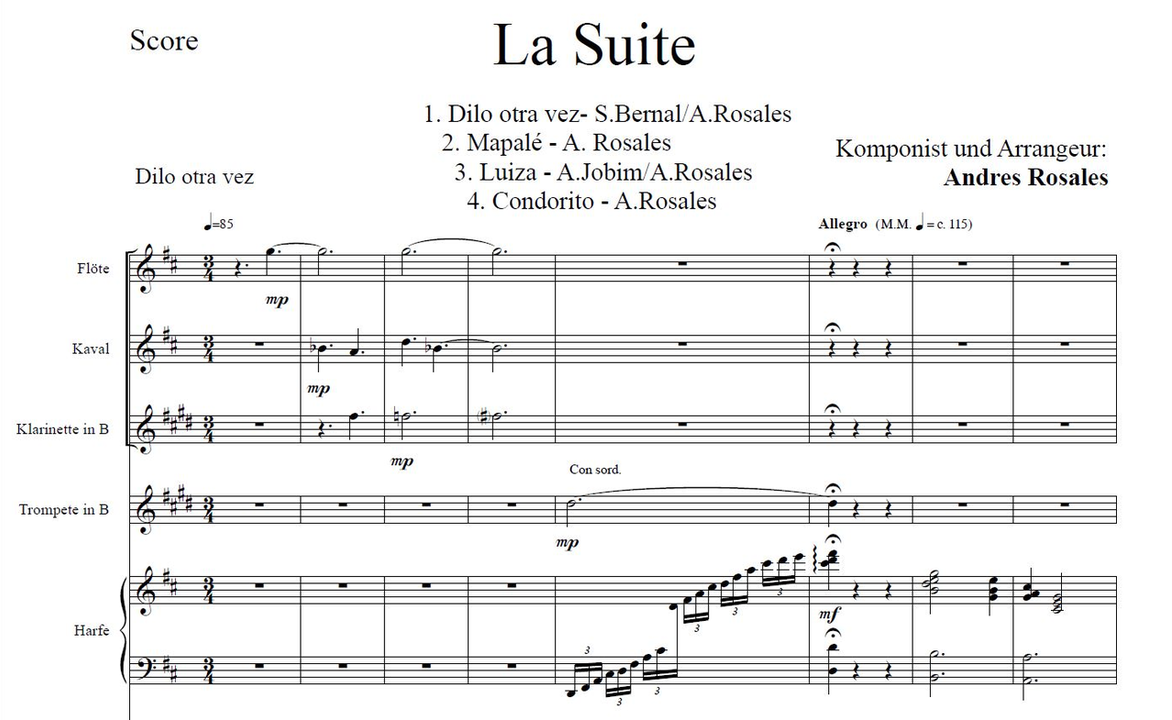
An example of this is the piece La Suite (see Bridges Kammerorchester 2020) by Colombian guitarist Andrés Rosales, who first came to Germany on a scholarship to study at the conservatory in Berlin. In this composition, he explores his identity as a Latin-American musician as well as the relationship with his home country. Coming to Germany triggered a recovery of the music that surrounded him in Colombia, although it had not really interested him at that time. He explains that in Colombia, his goal was always to play jazz and to compose classical music for orchestra (interview, October 29, 2021). La Suite is a reflection of both, as it serves the classical form of the suite, but each movement features a traditional Colombian dance (see Figure 1).
Figure 1. Andrés Rosales, La Suite, movement 1, excerpt from bars 1–8 (unpublished score, with kind per-mission by Andrés Rosales, all rights reserved).
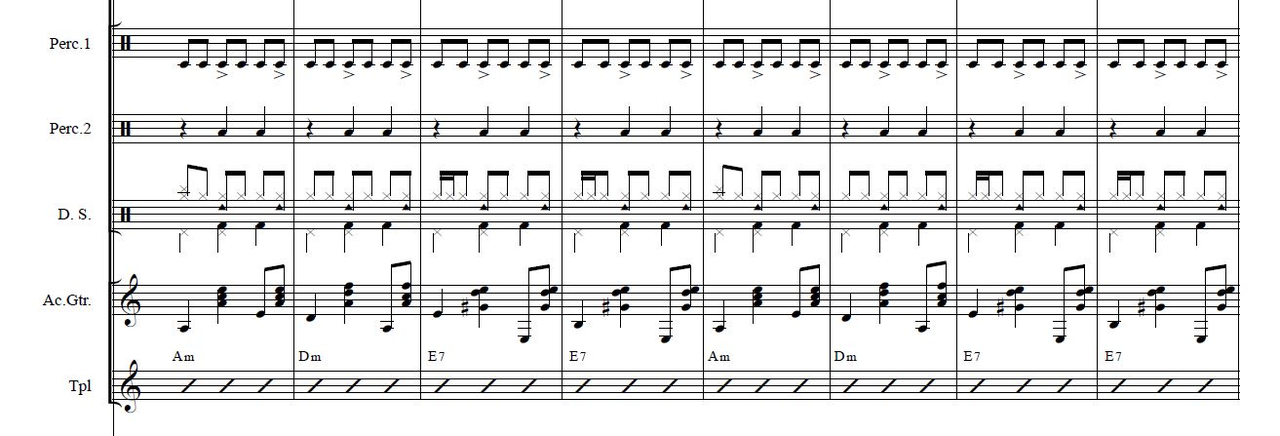
The first movement, “Dilo otra vez,” consists of a Colombian pasillo, a music and dance that was popular in Colombia, Ecuador, Venezuela, and Panama in the 19th century. It is often played on guitars, mandolins, and string instruments. In an interview, Rosales explains that he chose this representative form as the opening movement as well as for an arrangement of Antonio Carlos Jobim’s “Luiza” in the third movement (interview, October 29, 2021). The second movement takes the form of a mapalé – a Colombian dance with roots in the African continent (Sea 2012). It is in 6/8 time and features the typical mapalé rhythm, with a silent second quaver in the second percussion part (see Figure 2).
Figure 2. Andrés Rosales, La Suite, movement 2, excerpt from bars 98–104 (unpublished score, with kind permission by Andrés Rosales, all rights reserved).
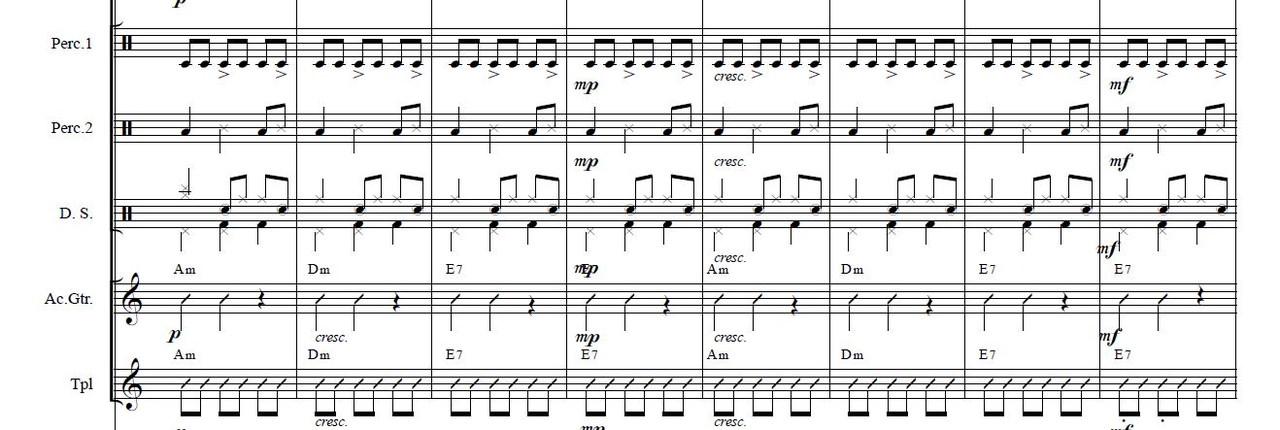
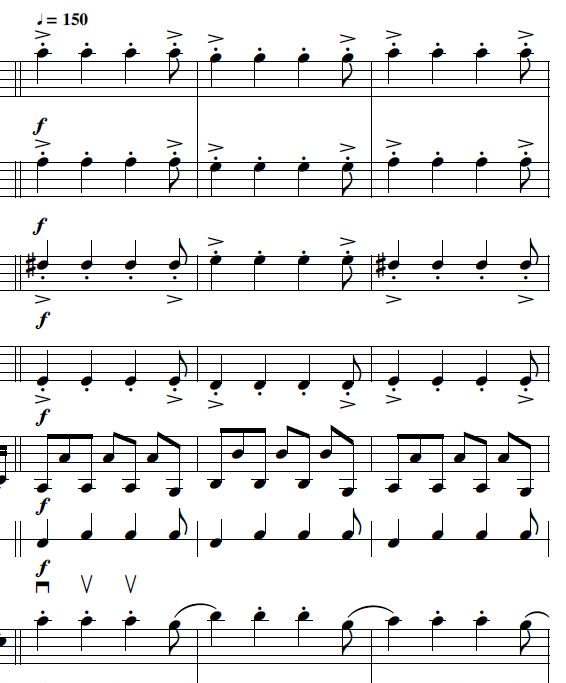
Rosales identifies the fourth movement, “Condorito,” as particularly traditional, not only because of the joropo dance form he chose, but also because of the two solo instruments, maracas and cuatro, both common in Colombian traditional music (interview, August 30, 2022). Maracas and cuatro determine the musical events of this movement – on the one hand acoustically, as they play dense, only slightly varied rhythmic patterns throughout (such as the example in Figure 3, or the condensed version in Figure 4), and on the other hand visually, as they are played in a soloistic manner in front of the orchestra, as described by Rosales (interview, August 30, 2022). The Colombian instruments are at the front of the orchestra and of the classical orchestral sound (aurally and visually), which recedes into the background in that movement.
Figure 3.La Suite, Andrés Rosales, movement 4, excerpt from bars 303–310 (unpublished score, with kind permission by Andrés Rosales, all rights reserved).Figure 4.La Suite, Andrés Rosales, movement 4, excerpt from bars 417–424 (unpublished score, with kind permission by Andrés Rosales, all rights reserved).
The composer not only roots his compositions in Colombian musical traditions, but also performs them, consciously presenting himself as a Colombian through playing the cuatro in front of the orchestra. During concerts, the works are usually introduced with a little background information about the composer by a host or the musicians themselves at times, meaning the audience will in all likelihood be aware of his identity as a Columbian and the country’s representation in this composition.
Creating as well as performing La Suite is part of the negotiation of belonging to Columbia that is relevant for Rosales. This can be heard in statements from the composer sounding somewhat wistful and nostalgic, describing the piece in terms of the landscapes of Colombia: “You can hear this [the piece] and you can just fly and you can put a different image of nature in your head, in this moment, of the mountains, of the beach, of everything” (interview, October 29, 2021). The piece is thus also an expression of his inner need to feel the connection to Colombia.
The same applies to Enkhtuya Jambaldorj, a multi-instrumentalist from Mongolia who came to Germany in 2000. She explains that playing music from Mongolia links her to her country of origin and becomes a vehicle to make her feeling of belonging to Mongolia tangible in her German-based reality:
Of course, when I make my music, I’m proud of it, right? Because in this way, I always have my homeland with me, these longings, right? This music also connects Mongolia and Germany, no matter if there are ten thousand kilometres between them. One thinks it’s very far away, how can one function here? Then, actually, that music continues to accompany me here. (Interview, July 6, 2021)
Musical practice thus evokes feelings of nostalgia and of belonging across a distance, to a far-away homeland. For the musicians in the ensemble with a migratory background, this represents a central motivation to participate.
At the same time, this connection to a “homeland” or a specific musical tradition evokes discourse not only about who belongs to a musical tradition but about certain musics belonging to someone – the question of who is allowed to play which musics or who is permitted to use which musical elements in their compositions. This is a question which is central to the ensemble’s artistic profile, given its focus on merging cultures and their musics, with all musicians participating in a new sound that comprises any ethnically marked musical elements the musicians bring along. The approach of viewing musical traditions and vernacular musics – such as traditional songs, particular rhythms, melodies and musical forms – as the seed for something new, while creatively engaging with the musical source material, also serves as an answer for this question, as the ensemble’s artistic director Johanna Leonore-Dahlhoff reports:
So, we actually have someone who would like everything to be totally traditional Arabic and then says: “Yes, the Germans can’t play that!” – and he’s right. We can’t do that. But the fact is, I also say that’s not what it’s about. It’s not about playing Vivaldi in historical performance practice, but rather about playing Vivaldi with the oud and then bringing in a colour that you certainly wouldn’t play if you were learning the lute [in Baroque playing styles]. And that means, something new is created. (Interview, July 15, 2021)
The fact that the artistic director is a musician who was born and raised in Germany, and that this premise of transculturality was not established by the migrant members of the orchestra, shows that the issue is nevertheless controversial, as do the conflicts described by musicians in this context. A German-born orchestra member, who also composes pieces for the ensemble, reports that some musicians felt personally attacked when elements of “their musical culture” were used or changed in new contexts (Interviewee 5, interview, January 28, 2022). He reports that he has been repeatedly confronted with resistance when trying to combine features from different stylistic contexts in one of their compositions: “I had almost given up. Because no matter how well I deal with traditions, no matter how much respect I show, so to speak, I’m not allowed to do that” (ibid.).
A musician with a migration biography also recalls that at times it was difficult to openly talk about musical ideas and the fear of doing something “wrong”: “In the past, we couldn’t even talk about anything together, and it was super difficult, musically speaking, I mean. Because everyone was afraid. People weren’t very open, so to speak, or they were afraid to discuss anything” (Interviewee 3, interview, November 4, 2021). According to several orchestra members, conflicts concerning the “right” way to deal with “foreign” musical traditions diminished over the course of the collaboration. The musicians became open to engaging with musical styles outside their own socialisation as well as with other performing styles from their own backgrounds – even if that consequently led to transforming those musical styles. This has led to a change in attitude among composers and musicians. Colleagues socialised in a non-western musical tradition are increasingly allowing dialogue about how different musical elements should be used. This enables musicians to influence how their musical heritage is used and thus avoid stereotyping. One of the composing musicians – one without a migration biography – reports:
But I realise that it’s also about a certain attitude. At the beginning, I made the mistake of saying, “Yes, here I want exactly your sound!” But I didn’t even allow for dialogue, where someone might say, “But this quarter-tone music doesn’t fit in here at all, I don’t want to do it that way.” And [realising] that as a composer and arranger, you simply have to be more flexible and not so narrow-minded and stubborn. (Interviewee 5, interview, January 28, 2022)
“Here I want exactly your sound!” – this statement reveals the core of the conflict. “Your sound” is a simplification in itself, which certainly does not do justice to the complexity of the musical traditions referred to. And the casualness with which the composer attempts to draw on traditions in order to realise a particular artistic vision reveals an absentmindedness that the musician reflected on and critically questioned following the experiences described. Musicians report that as the collaboration progressed, the understanding of the other musicians’ respective relationships to “their” music grew and the number of conflicts decreased. The experience of mutual “appropriation” of the colleagues’ music plays an important role here, though not in the sense of an unacknowledged or superficial borrowing for one’s own benefit. It rather involves an in-depth engagement that acknowledges and values the roots of each other’s musical traditions, along with the artistic potential and the conflicts that may arise from this encounter. Within these processes of negotiation, musicians take on the roles of “cultural bearers” – rooted in their musical tradition – and “cultural borrowers” (Balosso-Bardin 2018: 83). In this context, Balosso-Bardin (ibid.) refers to cultural bearers as musicians who are recognised – both by themselves and by their colleagues – as carriers of a specific musical tradition, having acquired its repertoire, stylistic conventions, and cultural meanings through long-term socialisation with it. Cultural borrowers are described as musicians who are not anchored in a single inherited musical tradition, but who move fluidly between styles, adopting and adapting them in response to changing musical contexts, while cultural bearers provide legitimacy to the tradition (ibid.: 86).While Bridges presents itself primarily as a group of cultural bearers, which entails the above-mentioned challenges of linking ethnic identity, representation, and musicians’ personhood, the distribution of the roles of cultural bearer and cultural borrower remains fluid, allowing musical practices to avoid becoming fixed or imitative: heritage is not treated as a static model to be reproduced, but as a resource being continuously reshaped through collaboration with musicians who move between styles. The musicians’ own experience of this fluidity represents an important resource for overcoming boundaries shaped by cultural heritage within Bridges.
This conflict also encompasses the ways in which working in the ensemble can serve as a resource for both migrant and non-migrant musicians. While a project like Bridges offers migrant musicians the opportunity to pursue their profession as musicians on a professional level and earn money, non-migrant musicians use it to expand their profile and present themselves as versatile artists. On the one hand, the classically trained musicians in Bridges in particular do not see themselves as “typical orchestra musicians” – a professional field they consider less creative and, in some cases, rather restrictive –, but rather as artists with greater creative freedom. Creating something themselves is an important element of their artistic identity. On the other hand, many of the musicians of Bridges who do not have migration experience express a desire to add the element of social engagement to their artistic identity. Unlike the migrant musicians, they derive additional benefit from playing in the ensemble, as they also have access to “conventional” institutionalised music.
Part of this process of asserting themselves within the context of these unequally distributed privileges – mirroring society’s general power imbalance – is the possibility of reclaiming the narrative of what the migrant musicians’ origins “sound like.” The crucial question is whether holding on to the idea of ethnically marked music – even if connected or mixed together – as a prerequisite for transcultural musical practice (as, for example, shown in the composition) is an artistic desire of the musicians themselves or a reaction to what the musicians perceive as the expectations of their environment (colleagues, the audience), regarding their work as migrant musicians in a transcultural ensemble.
For some musicians, this represents a rather ambivalent challenge. Salim Salari, a tar player from Iran who had performed with the ensemble for several years, recalled that he was expected to present himself as a representative of Iranian music, yet he struggled with the very music that was considered representative:
For example . . ., there was another colleague from Iran before, and he brought a song with him, and it was already in the repertoire, and after he left . . ., the piece was still in the repertoire. And it was very typically Iranian [laughs], which I, for one, didn’t like at all. I also said I didn’t like playing it because I’ve heard it so often in my life and it’s just a bit cheesy for me, so to speak [laughs] . . ., then they wanted me to tell the audience something about the piece. (Interview, July 5, 2021)
The challenge here was that, on the one hand, there is no such thing as “the” stylistically homogeneous Iranian music and, on the other, what is felt as “representative” can be highly individual. Salari felt uncomfortable with the direct and assumed connection between his country of origin and this music, which to him expressed various clichés and did not correspond to his conception of himself as a musician.
For the Bridges musicians with a migration biography, defining their own narrative through their musical practice in the ensemble also means countering processes of othering that they are faced with in society. For example, when I asked a member of the orchestra who was forced to flee their home country a question that was actually aimed at the influence of their migration biography on their compositional work, it let them to insist on distinguishing themselves from people with a refugee biography, positioning their journey as one of many throughout their life as a professional musician:
Actually, I’m not like others. . . . So, I don’t feel like a migrant. I’m a musician, an artist. I make art regardless, in [home country], in Europe, in Germany. So maybe this question doesn’t fit me. Maybe because I’ve played in Germany, in Italy, in Spain. And I think that my goal is art, no matter if it’s in [home country] or. . . Of course, I had a very long trip to Germany. Final trip, I mean, because it was all closed, the border was closed. And we had no visa, but yes, of course I had a long trip, and it was difficult with family and children. So, that was hard, too. But it’s not like. . . I think it’s. . . I’m a professional musician and I think about music always as art, not if it’s from [home country] or Germany. So that’s something different, what happened to me, with my journey, or my escape to Germany. So that’s something else. (Interviewee 4, interview, September 24, 2021)
With their experience as a musician and the frequent travel associated with it – especially in Europe – they place their flight as their last trip and see it more as a logical consequence of their traveling as a musician. As for many people with a history of fleeing their homeland, it is important for them to emphasise that they do not belong to a “needy” group of refugees, but to a group of artists who have something to offer to society (Brunner 2022; Parzer 2020). For migrant musicians, playing in Bridges is linked to the enhancement of self-worth, both externally and internally, and a form of self-empowerment. Their musical practice thus becomes a way of dealing with questions of social status and participation (Yuval-Davis 2006).
East – West: Connecting and Blending Musical Attachments
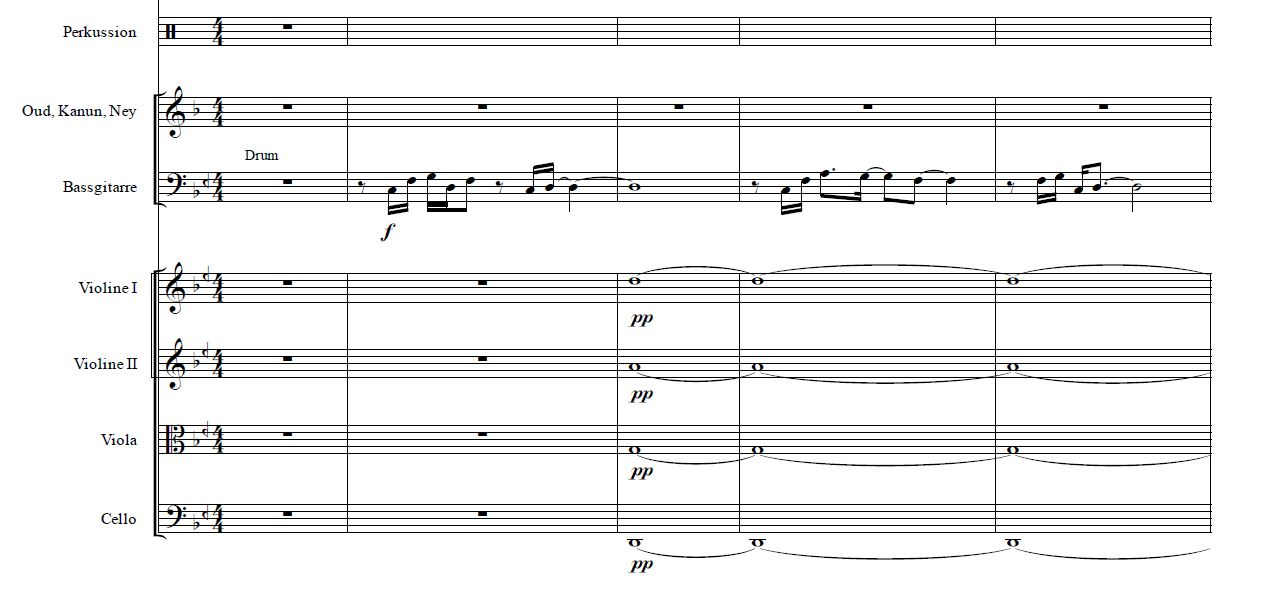
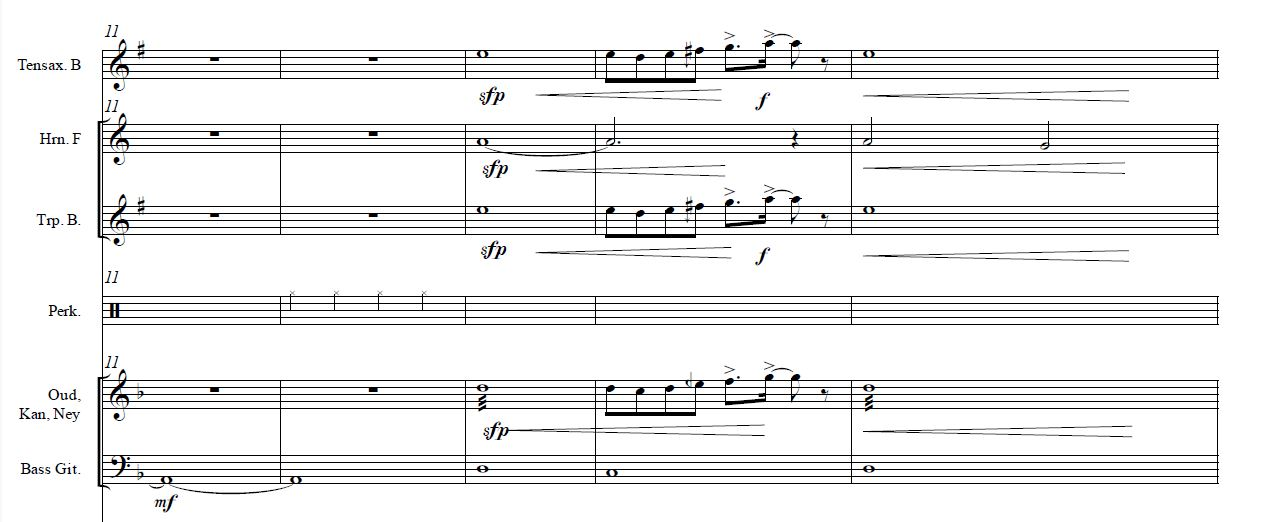
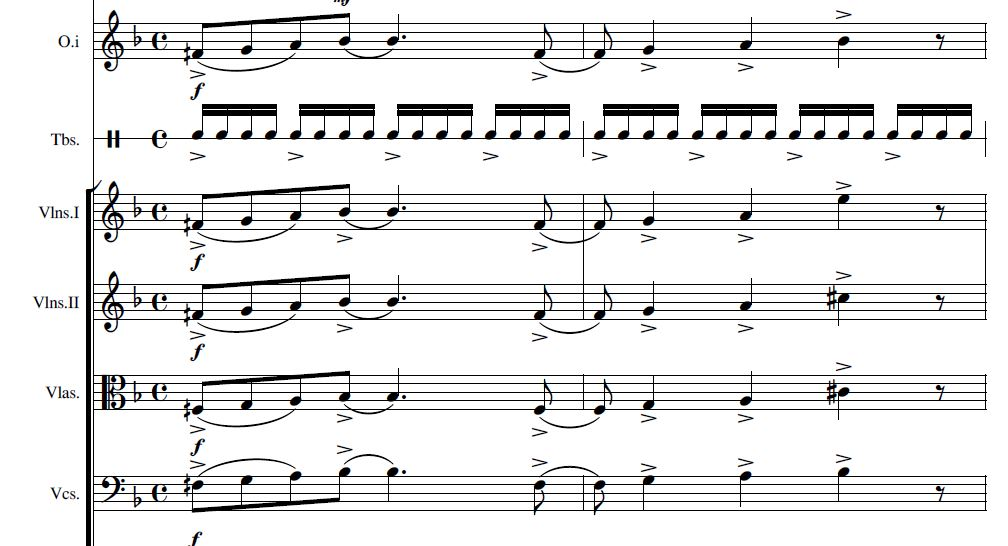
How the musical attachments of a composer are reflected in a transcultural context can also be discussed through two compositions by Syrian-born viola player Rabie Azar. The first is titled Zan (see Bridges Kammerorchester 2019). The title is an expression for beech wood; the composer recounts that he had a chair in his apartment in Syria made of such wood, an element that reveals a nostalgic sentiment towards his home in Syria. Azar describes the programmatic idea behind the piece as a connection between stylistic elements of Western music and those associated with music from the Arab world, as the “attempt to make music between Eastern cliché music and Western music or a bit of fusion music” (interview, September 9, 2022). In the case of Zan, Azar therefore opens up a world of sound that he describes as “jazzy” (ibid.), in addition to the orchestral sound. Azar’s equation of jazz and Western music is his perception of “jazzy” musical elements which can be found, for example, in Western popular music. The “Eastern cliché music” featured in the piece is characterised by Arabic maqamat.4 At the beginning of the piece, the “jazzy” impression is created, on the one hand, by the combination of bass and percussion (which is not notated in the score but rather left to the performing percussionist to create freely), which is characteristic of most jazz and pop genres in the form of the rhythm section (see Figure 5). In addition, the theme initially uses tonal material which in a jazz context might be described as D aeolian, enriched with the augmented fourth, which can be interpreted as a blue note. Of course, it could also be read as the maqam Nahawand, but, as Azar points out, his use of the scales is free and intuitive and not based solely on maqamat (interview, October 28, 2022).
Figure 5.Zan, Rabie Azar, excerpt from bars 1–5 (unpublished score, with kind permission by Rabie Azar, all rights reserved).
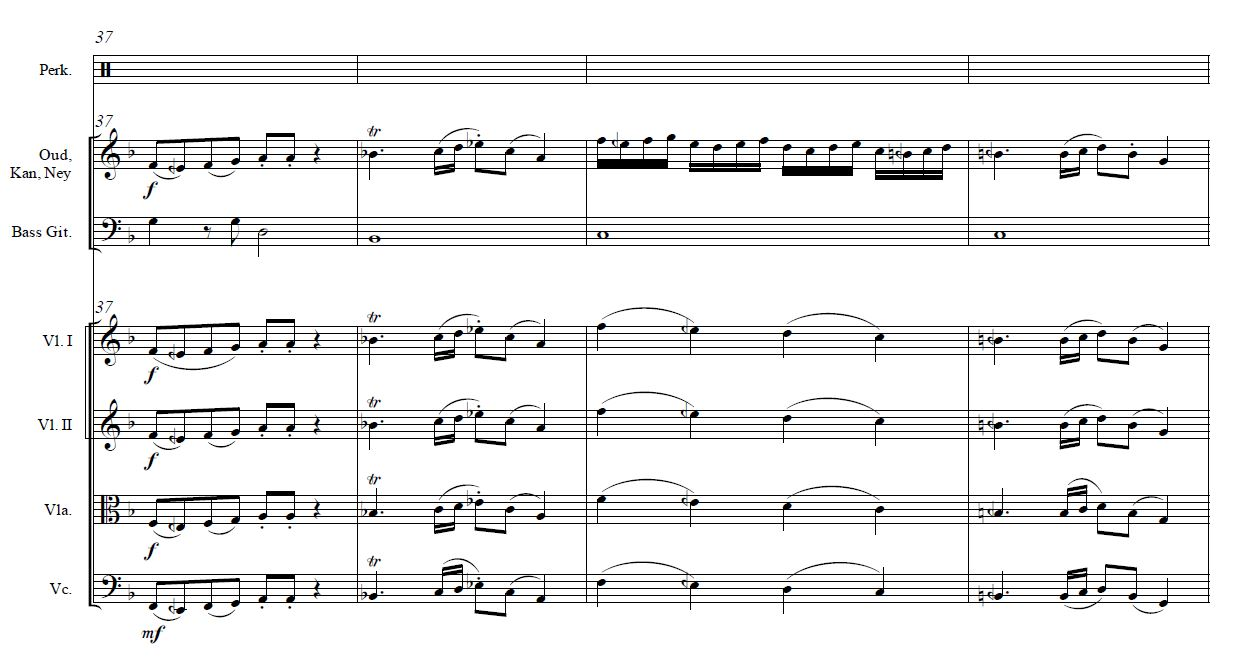
In bar 14, oud, ney, kanun, trumpet, and saxophone play a motif composed in the maqam Bayat. Azar, however, describes the rhythm as “Western,” referring to the syncopated conclusion of the motif, which might also be a stylistic element associated with jazz (interview, September 9, 2022; see Figure 6). Thereafter, Azar incorporates a theme which he says represents music from the Arab world (ibid.; see Figure 7). The use of the riq also intensifies the sonic impression; it complements the percussion group with shakers and tabla making them more present in the overall sound (not notated, but it can be heard in the recording).
Figure 6.Zan, Rabie Azar, excerpt from bars 11–15 (unpublished score, with kind permission by Rabie Azar, all rights reserved).Figure 7.Zan, Rabie Azar, excerpt from bars 37–40 (unpublished score, with kind permission by Rabie Azar, all rights reserved).
In his composition, Azar assigns the instruments to the different sonic worlds. The electric bass repeatedly plays an important role in this piece as a messenger of the jazzy timbre. This is especially evident in a very prominent bass solo in the middle of the piece, which is left entirely free for the bassist to improvise. In the concert recording referenced above, the bassist uses the slap bass technique, a common playing style in jazz and pop. Here, the saxophone clearly stands for jazz while the oud represents the eastern styles, as Azar puts it (interview, September 9, 2022). The solos are accompanied by bass and percussion (in this case, darbuka), and they almost sound like a jazz trio with a solo instrument, bass, and drums.
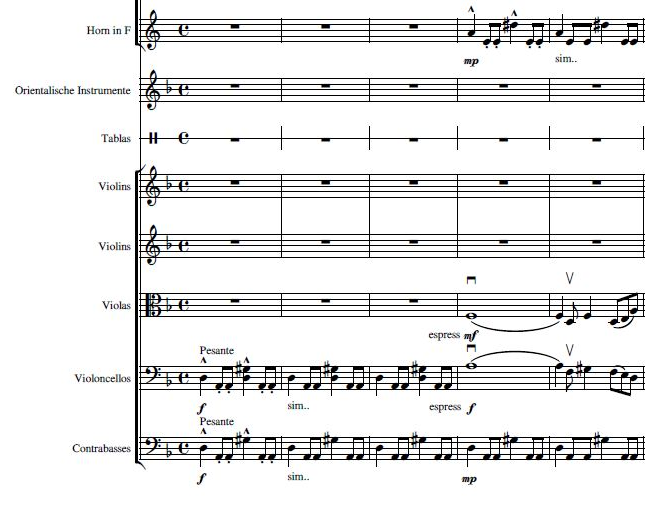
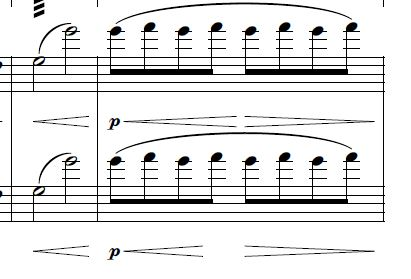
His piece Anater (see Bridges Kammerorchester 2021) – Azar uses the title as an expression for arches as a structure, reminiscent of the architecture from his homeland – works in a very similar way. Here, too, the aim was to juxtapose and fuse what he associates with “Western” and “Eastern” music – in this case combining microtonal5 maqamat with classical symphonic elements that remind him of the music of Gustav Mahler (interview, September 9, 2022): for example, the theme played by the horn at the beginning of the piece, which is accompanied in a march-like manner by a polyphonic string section (see Figure 8).
Figure 8.Anater, Rabie Azar, excerpt from bars 1–5 (unpublished score, with kind permission by Rabie Azar, all rights reserved).
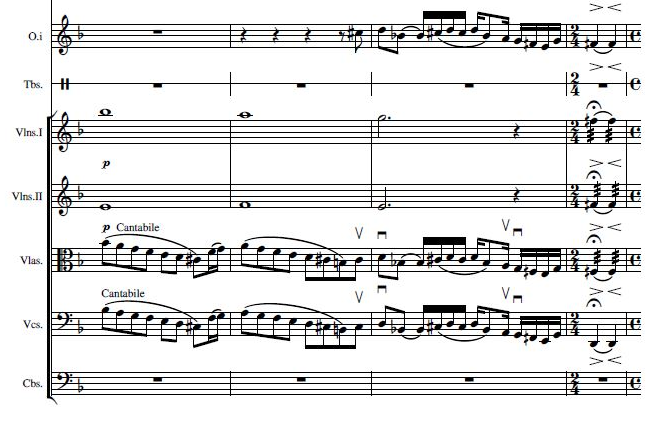
The world of “Eastern” music slowly creeps into the classical orchestral movement with the oud entering a descending phrase played by the strings, adding a microtonal note. In the following bars, the other instruments that Azar names “Oriental Instruments” in the score, which were left out of the “classical” introduction, can be heard for the first time (see Figure 9).
Figure 9.Anater, Rabie Azar, excerpt from bars 16–19 (unpublished score, with kind permission by Rabie Azar, all rights reserved).
The tempo now increases and the riq begins, while the strings, oud, and kanun play an ascending motif (see Figure 10), which is introduced in the following bars by various maqamat: Sikah is followed by Nahawand, Hijaz, and Bayat (interview, September 9, 2022). The composer incorporates microtonal structures from these scales into his piece, notating them, for example, as quarter tones (see Figures 9 and 10). This makes the change in musical character clearly audible, establishing a new sound world – however, it also proves to be a controversial issue in ensemble work. On the one hand, musicians who are not familiar with microtonal playing cannot simply perform it to the satisfaction of those whose musical socialisation it belongs to. Some of the composing musicians even consciously refrain from using microtonal scales in their pieces. On the other hand, there is disagreement about the musical contexts in which microtonal structures “may” be used – especially when, as described, the composer is not socialised in a musical tradition that includes them.
Figure 10.Anater, Rabie Azar, excerpt from bars 20–21 (unpublished score, with kind permission by Rabie Azar, all rights reserved).
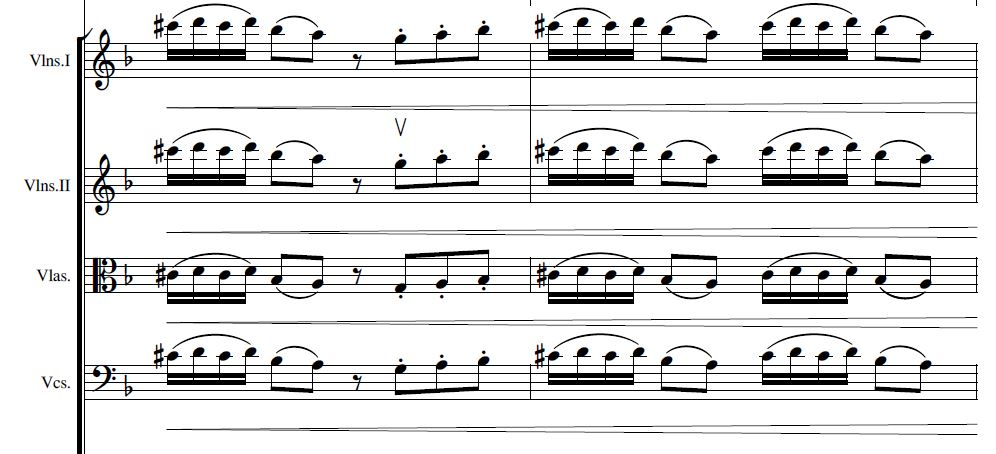
A section towards the end of the piece shows that Azar takes an almost literal approach to the representation of vernacular music by presenting different styles of what he describes as vibrato, but which appear more as ornamentations (in quavers and semiquavers) connected to certain regions (see Figures 11 and 12):
For example [hums alternating notes from the violins in bar 48], it was an attempt with the vibrato, we use different vibrato in the Turkish area, the Arabic area, or the Persian area, and slow vibrato [hums the same bars including the glissando notes] – I tried it like this with the strings. (Interview, September 9, 2022)
Over the course of the piece, Azar also incorporates a melody inspired by an Egyptian folk tune, which picks up on a rhythm that he clearly localises as Turkish as well (see Figure 13, interview, September 9, 2022).
Figure 11.Anater, Rabie Azar, excerpt from bar 48 (unpublished score, with kind permission by Rabie Azar, all rights reserved).Figure 12.Anater, Rabie Azar, excerpt from bars 57–56 (unpublished score, with kind permission by Rabie Azar, all rights reserved).Figure 13.Anater, Rabie Azar, excerpt from bar 87, rhythm homophonic in all voices (unpublished score, with kind permission by Rabie Azar, all rights reserved.
In summary, Azar says that the ensemble’s instrumentation already evokes what he partly aims to represent with scales, rhythms, and playing styles that he assigns to specific regions, as well as with quasi-quotations that can in fact be attributed to specific regions (interview, September 9, 2022). Thus, juxtaposition and connection become his musical language. The freedom to move between these musical worlds within a single piece is an important resource for Azar for developing his compositional language in this transcultural context, while also bringing together the different musics that influence him – even if these involve different traditions. However, the pieces, and the adherence to the East-West dichotomy they embody, also show that the boundaries between these dimensions are not dissolved by freely crossing them. Still, they are no longer relevant as obstacles, since they do not prevent musical elements from being used at all – they even function as an interesting element. Playing with them functions as an aesthetic feature of the composition.
Conclusion
The fact that the artistic profile of the Bridges Kammerorchester involves a mixture of musical traditions does not automatically mean that it has the potential to dissolve existing boundaries between these traditions and the associated expectations (Parzer and Mijić 2024: 51; Gaupp 2021: 49). They still exist and are actually part of the artistic self-image: the blending of music traditions presupposes their previous separation. Music remains present as ethnically or nationally marked, relevant for individuals and shaped by the composers’ cultural heritage. This is also evident in other parts of the repertoire where the reproduction of musical elements that can historically be assigned to certain regions is a frequently used narrative. Examples of these elements are rhythms, time signatures, scales, instruments, or characteristic playing styles, such as vibratos or improvisational forms, as well as musical forms or quotations from entire folk melodies or other compositions. This also includes the dichotomy of West and East, which is not only used by Azar as a musical narrative, whereby the meaning of West and East differs depending on the composer and the piece. Through the cultural labelling of musical elements or – even more so – of one’s own person, as for example a Columbian composer, some essentialising discourses remain present and are reconstructed by the musicians’ practices, tying ethnically marked traditions to their practice and identity. Rather than relying on a model of unequal encounters between fixed musical cultures, the focus has shifted to individual engagement within dynamic and increasingly complex global circulations of music. This perspective aligns with the transcultural premise, as for example adopted by Bridges, and emphasises the fluid and performative nature of identities. Nevertheless, claims of belonging and emplacement continue to shape musicians’ conceptions of musical traditions (Wood and Harris 2018: 9). At the same time, the ensemble creates a space where conflicts about what is “right” and “wrong” in the use of connotative musical elements can be negotiated and resolved not only on a technical, but also on a personal level. This frees the composers from the expectations connected to musical traditions and cultures as a distinguishing feature. Compositions such as Azar’s show that the reduction of the determining effect of cultural boundaries – even if those remain as such – presents itself as an artistic resource in terms of the use, recontextualisation, and modification of musical elements of the respective musical traditions. Musicians of Bridges simultaneously hold on to their musical socialisations and cultural heritage, which are also associated with feelings of nostalgia and longing, while enjoying the freedom of not remaining within the boundaries of their respective genres and styles – a simultaneity or contradiction that might not work in other parts of their lives but that does so in their artistic identities.
This freedom is not only an artistic resource for the musicians of Bridges, but also a social one. Those musicians with migrant biographies feel that the categorisation along the lines of ethnic labels by politics and the media, from which they suffer in everyday situations in the form of marginalisation, give way to a sense of belonging to the ensemble: the feeling of being part of a community arises among its members. Unlike other symphonic orchestras, which often bring people from different cultural backgrounds together as well, this connection happens not only on a superficial level, but on a deeper musical one. The negotiation processes described above, regarding musical elements within a tradition and the musical crossing of cultural boundaries, mean that the decentralisation of categories shaped by cultural heritage can happen more deeply and sustainably (De Martini Ugolotti 2022: 102). For example, the musicians might develop a sharper sensitivity to how their colleagues feel about their musical traditions – or, conversely, gain more confidence in engaging with those traditions respectfully when creating new, transcultural compositions. While in other areas of life – and reality shows that art and culture are no exception – marginalisation deters or prevents migrant musicians from participating, playing in an ensemble like Bridges offers a participatory experience and, with that, a place to belong – not only musically but also emotionally. Musicians with a migratory background value the fact that, unlike in everyday life, questions of “where someone comes from” are framed positively rather than critically or negatively. What often carries a negative connotation in a broader societal context becomes, within this artistic setting, a source of positive energy and creative freedom. One musician summarises this: “Everyone always asks in every conversation: ‘Hello, how are you? Where are you from?’ Immediately. But here at Bridges, you don’t need to ask that” (Interviewee 3, interview, November 4, 2021). The musicians also describe the feeling of being an important part of something bigger, as Rosales mentions: “And then I feel that I am a part of. . . wait, what is it called in German. . . [types something into the translator] – puzzle!” (interview, October 29, 2021). Compared with everyday life, at Bridges, being a migrant does not become the subject of a constant legitimisation process, but rather of artistic work.
What we see in the musical practice of this ensemble, then, is the creation of a space that provides musicians with a migration biography with agency to create their own (musical) narratives and modes of presentation. Here, we encounter the wish to present one’s homeland, but also to create new musical worlds by bridging different musical fields. The musicians are mostly situated within certain traditions and seek to use this as a resource, but also aim to discover other musical expertise they have or they might encounter in this transcultural environment, such as art music traditions or jazz. As such, working in this ensemble also provides the possibility to be just a musician, and not a migrant (Brunner 2022; Parzer 2020). In a way, Bridges creates a space in which the duality between belonging shaped by cultural heritage, also in music, while not being forced to perform it, is possible. This requires musicians navigating new artistic environments.
For those musicians with a migration background, living this duality also means a simultaneity of feelings of belonging to two – or more – realities of life: the one(s) they experienced in their country of origin and the one(s) they deal with now, in Germany. In the words of DeNora: musical practice becomes a form of “introjection” – a presentation of the self to oneself – reflecting the capacity to summon and sustain a coherent image of “who one knows one is” (2000: 62–63). Being part of Bridges resonates with the idea that who one is is shaped by multiple sources – including one’s migration biography as well as the various roles that migrants (have to) adopt in Germany. In this way, the orchestra becomes a space not only for negotiating different forms of belonging, but also for challenging them, through their staging of consciously transcultural musical works and externally imposed identities such as “migrant” in reaction to experienced politics of belonging (Yuval-Davis 2006). But this is not the end of the story: Related power structures, which are attempted to be dissolved on an artistic level through the greatest possible participation of all musicians concerning the creation and the development of the repertoire, are reproduced, for example, in the hierarchies of the orchestra management and the administrative team, in which no migrants were represented at the time of data collection. Particularly in the initial stages, projects such as Bridges involve complex dynamics and power relations, where apparent musical reciprocity often masks unequal expectations and interactions among participants (Wood and Harris 2018: 13). Viewers of the cited videos will have noticed that Bridges follows a conventional orchestral setup, even though it brings together musicians trained in musical traditions not all of which rely on written notation and role assignments like those in a Western European orchestra – which are often fixed rather than flexible. This setup itself signals a hierarchy of power. There is a conductor, and the musicians perform from written scores. Translating a musical style from its memorised or improvised form into notation can be said to compromise the integrity of the tradition (Bayley 2017: 103) and create a power imbalance between musical forms that are orally transmitted or shaped by improvisation and ornamentation and those in notated form. The fact that Bridges requires all musicians to learn new material through notation does not appear to create significant conflict, likely because many of the musicians trained in vernacular music traditions from their own cultural contexts have also received training in Western classical music (e.g. Interviewee 4, interview, September 24, 2021; Bayley and Dutiro 2016: 397).
This also pertains to working with a conductor. While working on a Mongolian Long Song6 proposed by Enkhtuya Jambaldorj for the repertoire, in which she performed both as vocalist and soloist on the horsehead fiddle, tension became evident that arises when a musical form defined by rich ornamentation and a free compositional structure is adapted to a setting led by a classical conductor:
At first, I didn’t understand it myself; the conductor often said, “You have to stay on the beat, Tuya, the beat.” But I had always sung this song freely, accompanying myself on the horsehead fiddle. Suddenly, with the orchestra, I had to stick to a fixed beat. And I also always had to watch the conductor, right? He kept telling me that. (Interview, July 6, 2021)
Within Bridges, the extensive involvement of orchestra members in the creation of the repertoire helps to mediate this discrepancy. Jambaldorj, for example, recalls that the situation with the Long Song was resolved by giving her the space to explain the form to her colleagues and the conductor, making clear what was important (to her). As a result, the orchestra came to understand its primary role as accompaniment, and the conductor followed the vocal line in conducting. This almost chamber-music-like approach challenges the musical director to adapt their role to the context. Bar Avni, one of the guest conductors who had worked regularly with the orchestra, describes a “special dynamic” at Bridges. Everyone felt free, at any moment – for example, during rehearsals – to speak up and offer comments (interview, October 30, 2021).
The musicians, as an ensemble, thus possess a certain self-confidence in shaping the pieces they perform – a confidence likely reinforced by the fact that many works originate from the musicians themselves. The dual role of musician-composer constitutes a central participatory element within the ensemble and an important component of Bridges’ “transcultural” identity. This is further reflected in the increasingly prominent role of composition in the ensemble’s external communications and organisational structures. In addition to composition workshops, in which orchestra members present their own works, analyse compositions by others, or discuss the specific instrumentation of a piece in relation to Bridges’ unique setup, the ensemble has, for several months, also referred to itself as “the composing orchestra” – a claim that features prominently in many of its marketing texts (Bridges Kammerorchester n.d.). More recently, the ensemble has emphasised collective composition, involving the collaborative creation of musical works by multiple orchestra members. This rather experimental and improvisatory approach to collective composition also serves as a bridge in addressing the discrepancy between non-Western and Western European musical traditions (Balosso-Bardin 2018: 100), as described above, particularly with regard to freedom of form, modes of transmission, and the fixation of musical material (Bayley 2017: 100). This approach also creates room for a “shared groove,” which Harris (2018: 53) describes as an embodied musical connection between musicians – and as a vehicle for transcending (cultural) boundaries. In this way, Bridges becomes a space in which the ideal of a shared space that facilitates such transcendence, while offering musicians the opportunity to experience themselves in relation to others, can be temporarily enacted, or at least imagined (Harris 2018: 54). For Bridges, this represents a continuation of the concept of transculturality. The collective compositional process, involving participants socialised in different musical traditions, inherently entails a search for intersections, commonalities, and points of connection between these traditions – an approach that aligns with the inclusive understanding of culture proposed by Welsch (1997: 75).
In summary, it can be said that for migrant musicians in the Bridges Kammerorchester, playing and representing music from their countries of origin compositionally can evoke a strong sense of emotional rootedness. Yet, the relationship to this music is not static – it shifts and expands, as musicians engage in new artistic and social environments, recreating feelings of belonging shaped by cultural heritage as well as nostalgia, while connecting and blending different musical attachments, thus transcending cultural boundaries. These boundaries are not dissolved but remain intact or are even reinforced, for example through the reproduction of narratives such as the East-West dichotomy or the adherence to a specific regional allocation of musical elements. At the same time, however, they are decentralised, as their divisive function is relativised, since moving across them freely in their musical practice is part of the fundamental artistic self-image of Bridges. A central tension emerges between musical adherence to a culturally shaped identity and the freedom to move between ethnically marked musical worlds. On the one hand, reclaiming musical traditions can be an empowering act of identity affirmation in the context of migration. On the other hand, this same process may challenge essentialist views of ethnicity. The result is a dynamic process of musical and social re-localisation, producing musical works that follow these negotiations through a new embedding, alteration, and combination of musical styles.
I conducted the interviews myself as an independent researcher. My role and the purpose of the survey were always communicated openly. It was not until well after the data collection had been completed (two years later) that I began working as a press and public relations officer for the ensemble, a role I had assumed at the time of writing this article.↩︎
All translations from German to English are by the author.↩︎
The website was redesigned in 2024, and the texts were revised in the process.↩︎
“The Arabic Maqam (plural Maqamat) is a system of scales, habitual melodic phrases, modulation possibilities, ornamentation techniques and aesthetic conventions that together form a rich melodic framework and artistic tradition” (Farraj n.d.).↩︎
Author’s terminology. In this context, the composers and musicians of the orchestra most commonly refer to “quarter tones.” However, since this term is ambiguous when applied to certain microtonal steps in maqamat – which in fact involve three-quarter tones – the more general term “microtones” is used here.↩︎
The Urtiin duu (“long song”) is a highly esteemed ritual genre in Mongolia, performed at major social and ceremonial occasions such as weddings, births, house inaugurations, and the naadam festivities of nomadic communities. Characterised by extensive ornamentation, falsetto, a very wide vocal range, and a flexible, non-metered structure, it is deeply rooted in the traditions of Mongolian nomadic culture (UNESCO n.d.).↩︎
References
Balosso-Bardin, Cassandre. 2018. “#NoBorders. Världens Band: Creating and Performing Music Across Borders.” The World of Music (new series) 7(1–2): 81–105. https://www.jstor.org/stable/26562976
Bayley, Amanda. 2017. “Cross-Cultural Collaborations with the Kronos Quartet.” In Distributed Creativity: Collaboration and Improvisation in Contemporary Music, edited by Eric F. Clarke and Mark Doffman, 93–113. New York: Oxford University Press. https://doi.org/10.1093/oso/9780199355914.003.0007
Bayley, Amanda, and Chartwell Dutiro. 2016. “Developing Dialogues in Intercultural Music-Making.” In The Routledge International Handbook of Intercultural Arts Research, edited by Pamela Burnard, Elizabeth Mackinlay, and Kimberly Powell, 391–403. Abingdon: Routledge.
———. 2024. “Ethnicity.” In The Routledge Handbook of Music and Migration, edited by Wolfgang Gratzer, Nils Grosch, Ulrike Präger, and Susanne Scheiblhofer, 70–74. Abingdon: Routledge.
Brunner, Anja. 2022. “Popular Music, Forced Migration from Syria, and Welcome Culture in Germany and Austria.” In Transformational POP: Transitions, Breaks, and Crises in Popular Music (Studies), edited by Beate Flath, Christoph Jacke, and Manuel Troike, 205–223. Berlin: IASPM D-A-CH. Accessed May 8, 2026. https://vibes-theseries.org/brunner-migration/
De Martini Ugolotti, Nicola. 2022. “Music-Making and Forced Migrants’ Affective Practices of Diasporic Belonging.” Journal of Ethnic and Migration Studies 48(1): 92–109. https://doi.org/10.1080/1369183X.2020.1790344
DeNora, Tia. 2000. Music in Everyday Life. Cambridge: Cambridge University Press.
Gaupp, Lisa. 2021. “Epistemologies of Diversity and Otherness.” In Diversity and Otherness. Transcultural Insights into Norms, Practices, Negotiations, edited by Lisa Gaupp and Giulia Pelillo-Hestermeyer, 13–61. Warsaw: De Gruyter. https://doi.org/10.1515/9788366675308-004
Harris, Rachel. 2018. “Applied Experiments in Collaboration Along the Silk Road.” The World of Music (new series) 7(1–2): 37–60. https://www.jstor.org/stable/26562974
Parzer, Michael. 2020. “Double Burden of Representation: How Ethnic and Refugee Categorisation Shapes Syrian Migrants’ Artistic Practices in Austria.” Journal of Ethnic and Migration Studies 47(11): 2459–2476. https://doi.org/10.1080/1369183X.2020.1826297
———. 2024. “Music-Making by Migrants from the Perspective of Sociological Integration Studies.” In The Routledge Handbook of Music and Migration, edited by Wolfgang Gratzer, Nils Grosch, Ulrike Präger, and Susanne Scheiblhofer, 379–406. Abingdon: Routledge.
Parzer, Michael, and Ana Mijić. 2024. “Continuity or Change? How Migrants’ Musical Activities (Do Not) Affect Ethnic Boundaries.” In Cultural Change in Post-Migrant Societies: Re-Imagining Communities Through Arts and Cultural Activities, edited by Wiebke Sievers, 39–58. Cham: Springer. https://doi.org/10.1007/978-3-031-39900-8_3
Präger, Ulrike. 2018. “Musically Negotiating Difference: Cross-Cultural Sounds of Empathy in Contemporary Germany.” In Musik und Migration, edited by Wolfgang Gratzer and Nils Grosch, 67–76. Münster: Waxmann.
———. 2024. “Enacting and Embodying Mobile Voices: ‘Musicking’ as a Tool for (Ethnographic) Migration Research.” In The Routledge Handbook of Music and Migration, edited by Wolfgang Gratzer, Nils Grosch, Ulrike Präger, and Susanne Scheiblhofer, 179–201. Abingdon: Routledge.
Richter-Ibáñez, Cristina. 2024. “Transculturality.” In The Routledge Handbook of Music and Migration, edited by Wolfgang Gratzer, Nils Grosch, Ulrike Präger, and Susanne Scheiblhofer, 165–166. Abingdon: Routledge.
Sievers, Werner, ed. 2024. Cultural Change in Post-Migrant Societies: Re-Imagining Communities Through Arts and Cultural Activities. Cham: Springer. https://doi.org/10.1007/978-3-031-39900-8
Stokes, Martin. 1994. “Introduction: Ethnicity, Identity and Music.” In Ethnicity, Identity and Music: The Musical Construction of Place, edited by Martin Stokes, 1–27. Oxford: Berg.
Welsch, Wolfgang. 1997. “Transkulturalität: Zur veränderten Verfassung heutiger Kulturen” [Transculturality: The Changing Constitution of Today’s Cultures]. In Hybridkultur: Medien, Netze, Künste, edited by Irmela Schneider und Christian W. Thomsem, 67–90. Köln: Wienand.
Wood, Abigail, and Rachel Harris. 2018. “Introduction: Sharing Space? Sharing Culture? Applied Experiments in Music-Making Across Borders.” The World of Music (new series) 7(1–2): 7–16. https://www.jstor.org/stable/26562972
Bridges Kammerorchester. 2019. “Bridges-Orchester: Rabie Azar - Zan (Buche).” Video of a live performance on April 26, 2019, YouTube, 4:31. Uploaded on July 18, 2019. Accessed May 8, 2026. https://www.youtube.com/watch?v=TBNcH9Zjcr8
———. 2020. “Bridges Kammerorchester: Andrés Rosales - La Suite, Konzert Capitol Mannheim.” Video of a live performance on February 27, 2020, YouTube, 10:56. Uploaded on April 7, 2020. Accessed May 8, 2026. https://www.youtube.com/watch?v=lZejrPeYjGo
———. 2021. “Bridges Kammerorchester: Rabie Azar - Anater live aus der Volksbühne.” Video of a live performance on June 18, 2021, YouTube, 10:56. Uploaded on March 25, 2022. Accessed May 8, 2021. https://www.youtube.com/watch?v=FoZjT23WEeA
Ethnographic Data
Avni, Bar. Interview by the author. Leipzig, October 30, 2021.
Azar, Rabie. Interview by the author. Frankfurt am Main, September 9, 2022.
———. Interview by the author. Frankfurt am Main, October 28, 2022.
Dahlhoff, Johanna-Leonore. Interview by the author. Frankfurt am Main, July 15, 2021.
———. Voice Message. Leipzig, July 26, 2023.
———. Interview by the author. Frankfurt am Main, June 10, 2024.
Interviewee 3. Interview by the author. Frankfurt am Main, November 4, 2021.
———. Interview by the author. Frankfurt am Main, July 13, 2022.
Jambaldorj, Enkthuya. Interview by the author. Frankfurt am Main, July 6, 2021.
Interviewee 4. Interview by the author. Frankfurt am Main, September 24, 2021.
Interviewee 5. Interview by the author. Frankfurt am Main, January 28, 2022.
Rosales, Andrés. Interview by the author. Frankfurt am Main, October 29, 2021.
———. Interview by the author. Frankfurt am Main, August 30, 2022.
Salari, Salim. Interview by the author. Frankfurt am Main, July 5, 2021.
Author Biography
Louisa Hutzler is a musicologist whose research focuses on music, migration, and cultural participation. She completed her PhD at the University of Salzburg with a dissertation on musical practice and repertoire in multiethnic contexts (with distinction, publication forthcoming). Her current research interests include music and inclusion. She has published and presented internationally and combines academic work with extensive experience in music outreach and project leadership. She currently teaches at the University of Salzburg and is the scientific-artistic Associate to the Leibinger Professorship for Transcultural Music Pedagogy and Music Mediation at the Barenboim-Said Academy in Berlin.