Sounding Together:
A Conversation with Musicians from the Jewish-Palestinian Peace Initiative Standing Together Vienna
Isabel Frey
Department of Folk Music Research and Ethnomusicology, University of Music and Performing Arts Vienna, Austria
Correspondence: frey@mdw.ac.at
Abstract
This edited conversation examines the role of music in the Jewish-Palestinian peace initiative Standing Together Vienna, which was founded in October 2023 in response to the Hamas massacre on October 7 and the unfolding genocide in Gaza. The initiative organized vigils to mourn all Palestinian and Israeli victims, as well as protests demanding a ceasefire and just peace in Israel-Palestine. In Austria’s polarized political climate these events opened an alternative space that named the structural imbalance of occupation and refused ethnonationalism and racism in every form. The conversation brings together four Vienna-based musicians, Marwan Abado, Natalie Adler-Oppenheim, Golnar Shahyar, and Sakîna Têyna, who reflect on their participation and musical performances at the movement’s first vigils in the fall of 2023. They discuss their motivations for participating in the movement, their considerations in choosing repertoire, and their experiences of navigating Austria’s repressive environment regarding discourse on Israel-Palestine, while also confronting pressures from within their own communities due to their participation in a joint initiative. The conversation contributes to ethnomusicological minority studies by exploring how diaspora musicians balance individual political articulation with community belonging in times of authoritarianism, war, and genocide. It illustrates how musical activism can contribute to peace work beyond romanticized notions of music as a unifier, by creating spaces of encounter where alternative futures can be imagined without flattening differences or power imbalances.
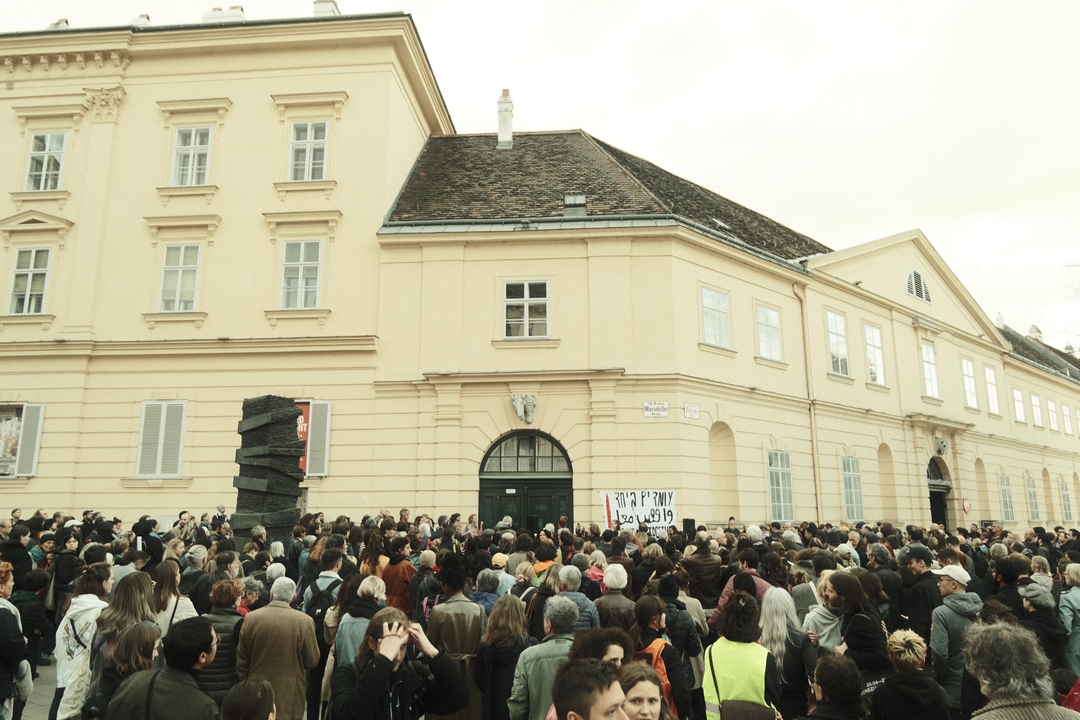
On October 22, 2023, a few weeks after the Hamas massacre of Israeli civilians on October 7 and as genocide in Gaza was starting to unfold,1 about 300 people gathered together on Vienna’s Platz der Menschenrechte (“Square of Human Rights”) in a vigil to mourn all victims of the bloodshed – both Palestinian and Israeli – and to stand together for peace, justice, and safety for all people living in Israel-Palestine (see Figure 1). There were no national flags or symbols, but candles, speeches by Jewish and Palestinian activists, and music, which helped to create a shared atmosphere of grief. What began as a modest gathering quickly transformed into a movement that attracted participants from diverse backgrounds: Jewish and Palestinian communities, other diaspora groups from the SWANA (South West Asia and North Africa) region, and Austrian people from the majority society. The vigil organizers – the Israeli-Palestinian art collective One State Embassy and I – decided to found the Jewish-Palestinian peace initiative “Standing Together Vienna”2 and continue to organize vigils and protests for a just peace in Israel-Palestine.
Figure 1. People gathering for the first vigil of Standing Together Vienna on October 22, 2023,
on Platz der Menschenrechte, Vienna (photo by Christopher Glanzl, with kind permission).
The initiative borrows its name from a movement in Israel-Palestine called “Standing Together/Omdim Bejachad/Naqif Ma’an,”3 despite not being affiliated with it. While it is inspired by the Israeli movement, it differs from it in scope and political framing, as it operates specifically within an Austrian and European context. The Austrian initiative deliberately sought to create a space for discourse on Israel-Palestine, a topic which, in light of Austria’s Nazi past, is highly polarized and politically fraught. It holds that space open for dialogue, coexistence, and the recognition of shared humanity while fully acknowledging the structural imbalance due to occupation, segregation, and the ongoing ethnic cleansing of Palestinians by the State of Israel.4 Standing Together Vienna rejects all forms of ethnonationalism and religious fundamentalism and stands against racism, particularly antisemitism, anti-Palestinian, and anti-Muslim racism, including in Austria and Europe. Since its inception, the group has demanded an immediate ceasefire, a deal to release the hostages and unjustly held prisoners, an end to occupation, ethnic cleansing, and genocide, and a just peace with human rights and equality for all people who live between the Jordan River and the Mediterranean Sea. In a polarized public discourse, the group thus occupied a middle ground in civil society.
From the beginning, music has been integral to Standing Together Vienna. At the public events and vigils, performances by musicians from various backgrounds based in Vienna or abroad were a central part of the program and fulfilled multiple functions for the affective politics of the movement: they created an atmosphere of collective mourning, made diverse cultural belongings audible and so produced an embodied experience of coexistence, and conveyed political messages (see also Frey 2025). The role of music in Standing Together Vienna differs from well-known Israeli-Palestinian musical collaborations, most prominently the West-Eastern Divan Orchestra founded by Edward Said and Daniel Barenboim (see Beckles Willson 2009), in that it is not conceived as a dialogue project in its own right. Rather, music functions here as part of political action: as a practice embedded in vigils and demonstrations, shaped by the specific positionalities and repertoires that each musician brings. At the vigils, they drew on various traditions from the SWANA region and other diasporic contexts. Coexistence was not staged through collaborative performance of a shared repertoire, but took shape across the sequence of performances, with each musical language keeping its own form.
This conversation brought together four musicians who regularly performed as part of the movement and invited them to reflect on their art and activism. Marwan Abado, a Palestinian singer, oud player, and composer, was born in a refugee camp in Lebanon and now lives in Vienna; Natalie Adler-Oppenheim is a Jewish-Israeli theater educator, musician, and activist; Golnar Shahyar is an Iranian-Canadian singer, composer, and multi-instrumentalist based in Vienna; and Sakîna Têyna is a Kurdish singer and composer who fled Turkey for Austria in 2006. The conversation took place online in November 2024 and was originally intended for an edited volume on the movement (Frey and Sayegh 2025), in which it was published in a condensed form in German. This is a more extensive version translated to English and edited for length and clarity.5
As the interviewer and organizer of this roundtable, I approached this conversation from multiple positions: as an ethnomusicologist studying the role of music in social movements, as a longstanding peace activist and co-founder of Standing Together Vienna, as a curator of the music program at the events, and as a Jewish musician who performs Yiddish music in activist contexts, including at the vigils. Both in writing this text and while conducting the interview, the boundaries between these various roles and positionalities sometimes shifted and dissolved. As Bergh and Sloboda (2010: 10) have noted, evaluations of conflict transformation projects tend to foreground success and underplay power imbalances. This conversation does not attempt to evaluate the initiative’s success but rather to document how musicians describe their practice, including the tensions and contradictions that emerge within it. My own proximity to the project inevitably limits the critical distance I can offer. At the same time, the “Forum” format of this journal, which is intended to provide a space centering the situated knowledge of minority practitioners, is well suited to this kind of participant-research and engaged ethnomusicology.
It is important to note that the musicians in this conversation and the initiative itself operate from the diaspora, at a considerable distance from the lived realities of people in Israel-Palestine. Diaspora activism carries a different weight and risk than political engagement within the region, but also different goals and publics: the primary addressee of Standing Together Vienna’s actions is Austrian civil society. At the same time, the musicians’ diasporic positions are shaped by varying degrees of proximity to the conflict. Some are more directly affected, like Marwan Abado, who grew up as a Palestinian refugee in Lebanon, and Natalie Adler-Oppenheim, who lived in Israel for over a decade and has family there. Others are more distantly connected. Golnar Shahyar’s involvement relates to the Iranian state’s role in the broader regional conflict and its instrumentalization of the Palestinian cause. Sakîna Têyna’s participation is grounded in the experience of Kurdish oppression in Turkey, which she sees as sharing structural parallels with both Palestinian and Jewish dispossession. This conversation cannot claim to represent or substitute for voices from within Israel-Palestine, where people are most directly affected by the political stakes of these debates. Instead, it traces how musicians navigate the intersection of biographical history, political commitment, and artistic practice in a specific local context – Vienna – where discourse on Israel-Palestine is shaped by Austria’s own political dynamics and historical responsibilities.
This publication also responds to the increasingly authoritarian shift in many liberal democracies as regards the discourse on Israel-Palestine. Particularly in Austria and Germany, those from the artistic and academic sectors who criticize the State of Israel or express solidarity with Palestinians may face harsh repression if not outright criminalization, often with severe consequences for their work and livelihood. This shift was enabled by the increasing weaponization of antisemitism accusations against criticism of Israel’s actions and against Palestine solidarity movements. It follows a longer development in which the political right has hijacked Jewish history and pain for its own gain. This dynamic positions Jews and other strategically “accepted” minorities against Muslims, non-white refugees, Iranians, Arabs, and Palestinians (see Klug 2020; Pisanty 2021; Tzuberi and Piberger 2022). The musicians in this conversation navigate these restrictions differently based on their own positionalities: some find themselves facing implicit racist assumptions or outright exclusion or repression from the majority society, while others confront accusations of betrayal for participating in a joint initiative from within their own communities. Tensions also emerged within the initiative itself: the double framing of Standing Together Vienna – of mourning all victims while advocating for a just peace – was experienced differently by participants as the situation in Gaza escalated.6 The tension between a framework of shared mourning and one of explicit solidarity with Palestine remains unresolved, as becomes apparent at several points in the conversation that follows.
These musicians’ reflections on their involvement with Standing Together Vienna and their perspectives on the struggle for a just peace in Israel-Palestine touch upon topics that are relevant to wider ethnomusicological minority studies: how musicians balance their individual politics and artistry with their belonging to an ethnic community or diaspora, how they navigate the racist and repressive environment of the majority society, and how they nevertheless find ways to draw on music as a tool to express solidarity or prefigure alternative futures for the SWANA region and beyond. Letting the musicians speak for themselves rather than writing only about them has become an established standard in ethnomusicological minority research (which is also part of the goal of the new “Forum” section of Music & Minorities). It also corresponds to Standing Together Vienna’s stance, which from the beginning sought to center multiple voices speaking from lived experience and personal connections rather than abstract political analyses.
On a broader level, this conversation asks what music does in peace and solidarity movements beyond the assumption that music unites on its own. It explores how music can create spaces to acknowledge complexity and to imagine alternatives to violence and separation without flattening out differences. We might consider these musicians as partaking in building “minority alliances,” a concept that emerged from a non-academic, activist context to denote a strategic linkage of struggles. It was coined by Hakan Gürses as part of the Initiative Minderheiten, the Minorities Initiative, an association co-founded by ethnomusicologist Ursula Hemetek in 1991 to advance the rights of minorities in Austria and provide a joint platform for them. In a programmatic definition of the term in the early years of the initiative, Gürses wrote, “Alliance does not mean giving up one’s own. . . demands, nor does it mean complete identification with all the concerns of the alliance partner” (1994: 367).7 The musicians of Standing Together Vienna engage in building minority alliances as strategic linking of different struggles, from Palestinian and Kurdish liberation to “Woman Life Freedom” and the fight against antisemitism, racism, and fascism in Europe, without collapsing one into the other. They do so by recognizing how systems of oppression intersect and what different liberation struggles can learn from one another, while remaining attentive to their particular cultural context.
When Jewish, Palestinian, Kurdish, and Iranian musicians perform alongside one another in a shared space of grieving, it creates an embodied experience of a future not organized around ethno-religious and racial divisions. It can be seen as an exercise in what Michael Rothberg (2009) calls “multidirectional memory,” which runs against the competitive tendency to treat memory as a zero-sum game, in which one group’s collective memory comes at the expense of another. In the musical practice of Standing Together Vienna, different historical narratives coexist without canceling each other out. It is a way of “sounding together” that lets the particular affiliations of the musicians and musical traditions stand, holding them together in a not-yet-established future. Such prefigurative politics, where the means of protest reflect the desired ends, can be especially meaningful in a context where many have lost the ability to imagine alternatives to endless violence. Music’s ability to contribute to peace-building does not work by imposing a false sense of harmony in a context of war, but by creating spaces where conflict can be acknowledged, where grief can be expressed, and where new possibilities for coexistence might emerge.
Note
This conversation took place in November 2024 and reflects on the movement’s early months in fall and winter 2023. At the time of this interview, subsequent developments that would unfold in Gaza from late 2024 into 2025, including the intensification of systematic starvation, the large-scale destruction of civilian infrastructure such as hospitals, schools, and universities, and the near-complete displacement of the population of northern Gaza, had not yet occurred. The musicians’ words reflect the political situation as they understood it at that moment.
Isabel Frey: Why did you decide to perform at a Standing Together Vienna vigil in the first place, and how did you feel about your participation?
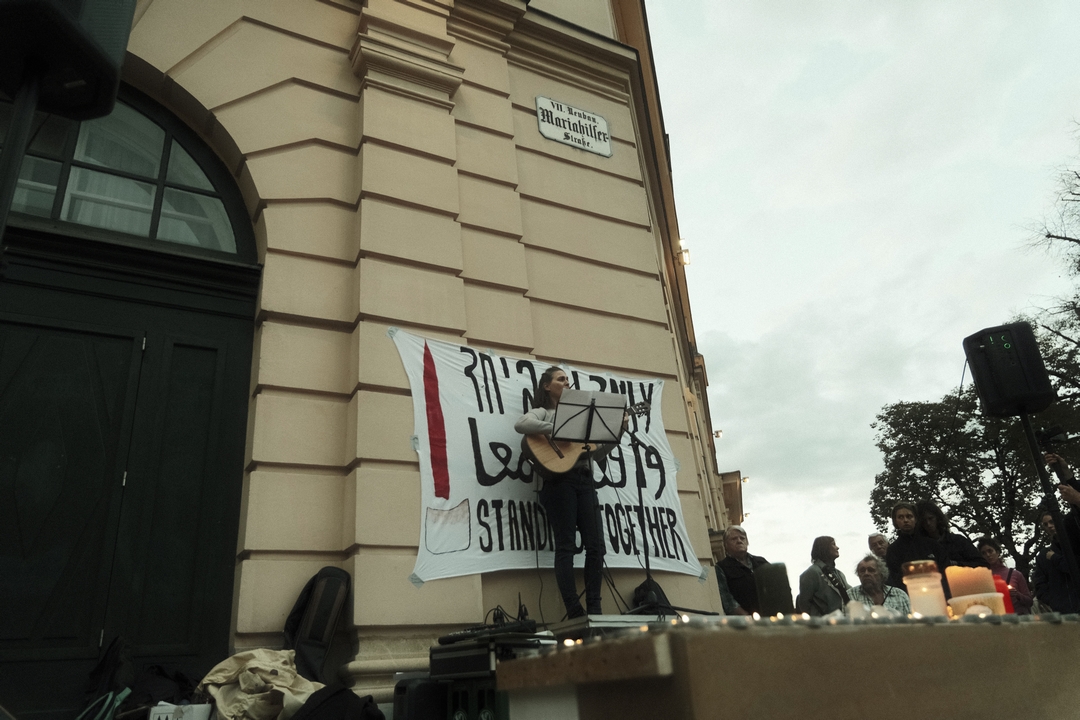
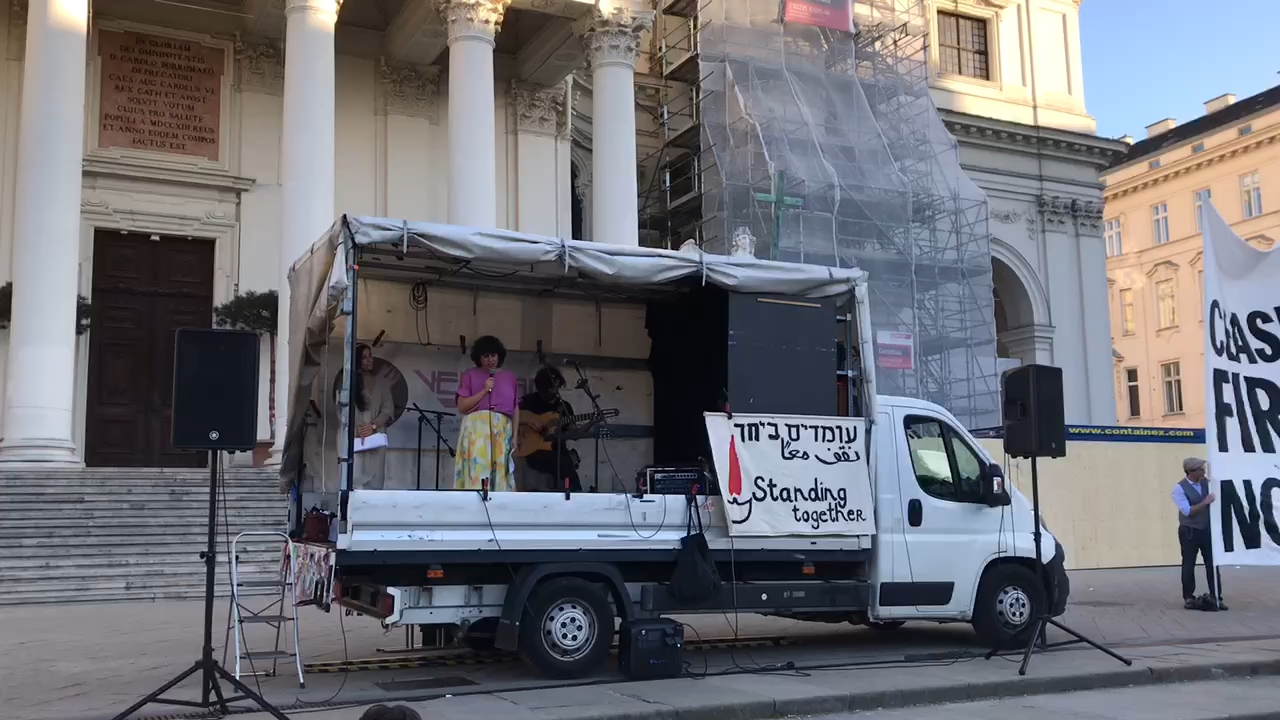
Natalie Adler-Oppenheim: I was part of it from the beginning. I was deeply shaken by the events of October 7 and Israel’s disproportionate response, and I felt the urge to take to the streets and raise my voice, but not only on one side – not only with the Jewish or the Palestinian community. I wanted to stand up for all the victims. When we decided to organize this together, I was very happy to be part of it, by moderating and coordinating the vigils and by performing there (see Figure 2).
Figure 2. Natalie Adler-Oppenheim performing at the first vigil of Standing Together Vienna on October 22, 2023, on Platz der Menschenrechte, Vienna (photo by Christopher Glanzl, with kind permission).
Golnar Shahyar: As an artist who has also worked in the cultural sector in different spaces, I realized over the years that the topic of Israel and Palestine had been heavily suppressed. The situation was very one-sided. When I first came into your space, it was the first time that I found acknowledgment of the complexity, the history, and the pain of both sides. It was a very inviting space for me. There were also many conflicts about how to approach the topic, but I felt that our commitment to choosing dignity and communication kept the people together, and there was a process of growth in the tone of our conversations. If we can’t sit down with people we disagree with and talk to each other, then there is no way forward. And in this space, I sensed a willingness to engage with the Other – at least among the ones who stayed.
Sakîna Têyna: For me, there are several reasons why I became involved. Firstly, the situation [in Israel-Palestine] was so appalling that I really wanted to do something and raise my voice. And then there is a second, very personal reason: as a member of an ethnic minority, I have had similar experiences. It has always been a dream of mine to found an initiative like this together with Kurds and Turks. There is this collective trauma that we experience everywhere in the region. I was also there for myself to find healing. I had wanted to go to Palestine solidarity demonstrations, but when I saw hundred-meter-long Turkish flags or Islamic fundamentalists there, I could no longer identify with them. At the same time, I also couldn’t identify with the demonstrations with only Israeli flags. That’s why I felt at home with this initiative right from the start.
Marwan Abado: I am a child of this conflict. I grew up in the war, in the diaspora in Lebanon, and Austria is the second stop of this diaspora. I am a very politically engaged person, and I have led many solidarity demonstrations in Vienna. But this was the first time in my life that I decided not to take part – especially on the Palestinian side – because it felt very strange to me that the conflict had been turned into a religious one. Standing Together Vienna was the only platform I could really identify with, where I could show my personal respect for all the victims: as a person, as a Palestinian, and as a musician. In the beginning, I was in a state of shock. I received many interview requests and didn’t give a single one. I couldn’t speak about it. Standing Together was an incredible platform that confronted this very repressive public and made no distinction between the victims. Every victim counts, whether Palestinian or Israeli. Declarations of solidarity were usually directed either towards Palestine or towards Israel, but thousands of Israelis and Palestinians don’t agree with that. In the movement, I felt I could raise my voice and sing without having to talk about it, even though I didn’t agree with everything that was said there politically. Che Guevara once said that solidarity is the tenderness of peoples. For me, this was one of the most tender spaces in this conflict.
Shahyar: Another important reason for me is how I understand the “Woman Life Freedom” movement. I understand it the same way you described it, Marwan: as this tenderness, this protection, as safe spaces to come together and understand each other. You can’t just keep reacting from a place of trauma and anger. And I feel that you in Standing Together Vienna have done this work, this reckoning with history and with your traumas. I’m not saying that this process is complete, but there is at least an awareness of it, and I feel protected here. For me, it’s a way of life, not a political movement that belongs to a particular country. I understand this way of coming together, of exactly these voices, and I hope it becomes a culture of its own – whether Iranian, Kurdish, Palestinian, or Israeli.
Têyna: We watched a livestream of a joint Palestinian-Israeli mourning ceremony once, and I said to myself, “Exactly this is the dream.” I’m over 50 years old now, and I had never before experienced a dream becoming reality like that. In my country, you can’t really bring these two groups [Kurds and Turks] together and talk about the problems in the same way – with tenderness, music, culture, history. That’s why, as Golnar says, you can find identification for your own struggle and your dreams there.
Frey: I like what Marwan said earlier: how music can express something when you are not able to speak about it. How did you choose what music you would play at the Standing Together Vienna vigils? And more broadly speaking, how do you see the connection between music and politics?
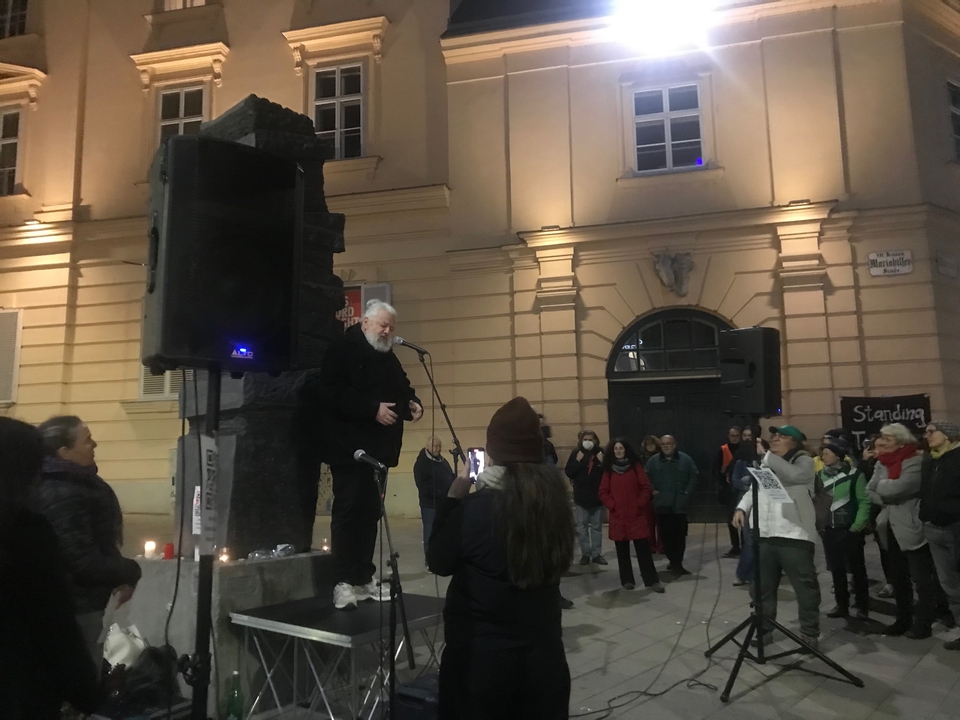
Abado: The choice was easy for me because I had already written songs on this topic. I wrote one song with the lyrics “Every day there is news in a land called Palestine” (Audio Example 1). It’s about the counter-image to heroism and martyrdom. At the time, I wanted to challenge this clichéd image of Palestinians in the Arab world, that we all want to die for our struggle. Unfortunately, this cliché is still omnipresent today. I sang this song at the vigil (see Figure 3) with a clear message: “No, we are not. We actually want to live.” I wish for a boring day – a very ordinary day. And this boring day will be a holiday in a country called Palestine.
Figure 3. Marwan Abado singing “Kul youm” at the vigil of Standing Together Vienna on November 5, 2023, at Platz der Menschenrechte, Vienna (photo by Isabel Frey).
كل يوم / Kul youm (“Every Day”)
Words and music: Marwan Abado; English translation: Sharon Alley.
كل يوم في خبر،
Every day there is news,
كل يوم في صور،
Every day there are pictures,
عن بلد إسما فلسطين.
About a country called Palestine
كل يوم في صراع،
Every day there is fighting
كل يوم في وداع،
Every day there is farewell,
في بلد إسما فلسطين.
In a country called Palestine.
حابب يجينا يوم،
I wish us a day,
خالي البطولي،
Without heroism,
لا شهيد،
Without a martyr,
ولا جريح،
Without injuries,
كلوا ملل، وكلوا ضجر،
A very boring, banal day,
وهاليوم الطبيعي، من الطبيعي
And this ordinary day
يكون عيد، في بلد،
Will be a holiday,
إسما فلسطين.
For a country called Palestine.
Audio Example 1. Marwan Abado singing “Kul youm” at the vigil of Standing Together Vienna on November 5, 2023, at Platz der Menschenrechte, Vienna (recording by Mitja Milosits, with kind permission of Marwan Abado).
Abado: Then I sang a song with Nadine Abado about the moon as a beauty ideal (see Video 3 below). For me, it’s a political song. War is the only machinery of destruction that actually works well in our lives as human beings. If you hold on to beauty in the midst of that. . . maybe it’s just a butterfly’s dream, but there still is something in it, for me.
Adler-Oppenheim: I also played a song of mine that deals with Israel-Palestine (Video 1). After eleven years of living in Israel, the conflict has become an important part of my life. The song points out the similarities: showing that both peoples have been persecuted and that all they want is a country where they can feel safe. There was a Jewish movement at the end of the 19th and beginning of the 20th century, the Bundists, who, unlike the Zionists, said something like: “We don’t want to live anywhere else, because if we go somewhere else, the same problem will continue. Leaving won’t solve racism. So we stay here in Europe and join forces with other oppressed minorities in this struggle against racism.” Antisemitism is also just one type of racism, and we must join forces to fight against it. The same applies to Israel-Palestine: both peoples live there, and we have to manage to live well together. The song ends with a utopia of a country where everyone can live in peace.
Dojkajt (“Hereness”)
Words and music: Natalie Adler-Oppenheim.
Long ago we were torn between such lines
Israel and Palestine
One was strong, the other seemed forlorn
Long ago land was seized and blood was shed
You take my home, you take my bed
Give me my freedom
Leave me my land
Here I live, here I breathe
Here I belong, here lies my freedom.
Long ago we were dreaming of a land
Zion, yes Israel
Taken from our homes
And turned to bones
And then one day, one was paid as the other one was forsaken
Nearly 75 years of this cruel oppression
You put your hand upon my door, your feet upon my floor
You put your ears upon my walls, my face upon your phones
Controlling all of my supplies, as my produce
When will this ever come to end, will we be free?
Here I live, here I breathe
Here I belong, here lies my freedom. Dojkajt, do zu zajn
Do iz majn land
Do iz majn frajhajt
Ana huna ajishu
Ana huna atanafasu
Ana huna antami
Una takmun huryiati
Nanana. . .
Dojkajt, do tsu zajn, Hereness, here I am
Huna ana. . .
Here we’ll be free
In harmony, in fraternity!
Here we build a world to be.
Dojkajt, do tsu zajn, Hereness Alwujud Huna
Nananana. . .
Long ago, we have learned to live together
We have ploughed each other’s earths for better
Faced with the tasks ahead of us
We’ve come together
To see prosperity and peace
Embraced each other
Stronger than ever, finally we prosper
Zusammen, maanan, beyachad
Ken rak beyachad
Nimtsa et cheruteynu
Da liegt majn Freiheit
Huna takmun huryiati
My land’s my freedom
Ardi hi huryiati.
Video 1. Natalie Adler-Oppenheim performing “Dojkajt” at the vigil of Standing Together Vienna on October 22, 2023, at Platz der Menschenrechte, Vienna (recording by Benjamin Urbanek, with kind permission of Natalie Adler-Oppenheim).
Adler-Oppenheim: My other performance was a cover of the song “Woodstock” by Joni Mitchell. It’s about something being in the air and change being possible. I included the vigils and adapted the lyrics a bit by adding: “I’m going on down to our vigil tonight, we’re gonna raise our voices high.” At the beginning [of our movement], after October 7, there was a feeling that something might now be broken open, that peace might somehow be reached.
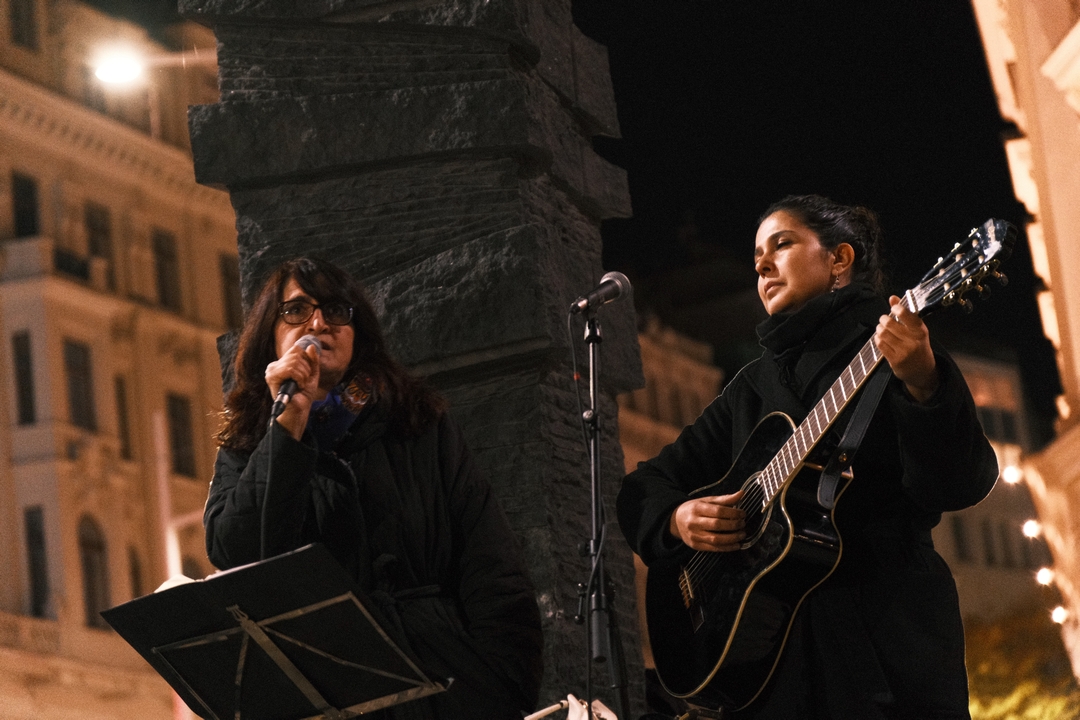
Têyna: I sang Kurdish songs. It wasn’t that hard to choose because our history offers many appropriate songs. One was about a girl who was killed in Dersim in 1938 (Audio Example 2, see Figure 4). At that time, 75,000 Kurds were killed. People hid in caves, in the forest, in the mountains. Sometimes they had to kill their children, afraid that the soldiers would hear their children crying and find them. The Turkish newspapers at the time wrote that blood flowed in the river instead of water, and they were proud of it. We also sang a song about flight, because flight follows war. It is a lullaby: a mother wants her child to sleep and sings: “Go to sleep, go to sleep, today the wild mountains are our home.”
Figure 4. Sakîna Têyna and Özlem Bulut performing “Çênê” at the vigil of Standing Together Vienna on November 5, 2023, at Platz der Menschenrechte, Vienna (photo by Christopher Glanzl, with kind permission).
Çênê (“My Daughter”)
Words: Hayati Mutlu and Metin Kahraman; Music: Metin Kahraman; English translation: Sakîna Têyna.
Çênê çênê, çena mina rindeka min
My daughter, my daughter, my only one
Çênê çênê çênê, çêna mina delala mi
My daughter, my daughter, my beautiful one
Çêna mi axwê berda, ax dilo cîgera mi vêsena
The Munzur River took my daughter away, ah, my heart is burning
Ez nika sepkêrî kamrê vacî
What should I do now? To whom can I cry my sorrow?
Derdê çêna mi kî zof girano
The pain of my daughter is immense
Lê liminê lê liminê limin axwe berdê ez sêbikêrî
Oh the river took my daughter away, what should I do now?
Hîriso hêşto marê marê serrê dê şiyawo derdo
The year ’38 was a dark, sorrowful time for us
Hard û asmên bêro zonê
Let the earth and sky speak,
Cîgeram kê torê qese bikero
Let them tell you what we witnessed
Ez nika sepkêrî kamrê vacî
To whom can we cry our pain?
Derdê hardê Dêrsîm zof girano
The sorrow of the land of Dersim is immense
Lê liminê lê liminê Derdê hardê Dêrsîm zaf girano
Ah the sorrow of the land Dersim is immense
Lê liminê lê liminê limin axwê berdê ez sêbikêrî
Oh the river took my daughter away, what should I do now?
Audio Example 2. Excerpt of Sakîna Têyna and Özlem Bulut performing “Çênê” at the vigil of Standing Together Vienna on November 5, 2023, at Platz der Menschenrechte, Vienna (recording by Mitja Milosits, with kind permission of Sakîna Têyna).
Têyna: I also sang about Sema, one of the few Turkish women who joined the Kurdish liberation struggle, who was half Arab, half Turkish. She was a freedom fighter and she burned herself to death in Sweden when she was unable to return to the mountains after being injured in the war. In her letter, she wrote: “I hope that the fire from my body will create a bridge between all the peoples in our area and finally bring peace.”
I also sang about the three Kurdish activists who were killed in Paris. It was important for me to show that these political conflicts don’t just happen in this region. The actors involved also have many contacts and receive a great deal of support in the West. How is it possible that three Kurdish women could be killed in the middle of Paris, 150 meters away from a bar? Would this have been possible without the support of certain groups? These wars happen there, but they also have connections here. That is what I wanted to address, and that is why I chose these songs.
Shahyar: I sang three pieces. One was called “War” (Video 2); another was an Afghan song. Both songs acknowledge grief and trauma. I wanted to name this helplessness and this deep pain that is there. The third song was called “Ray of Light” and it’s a song about hope (see Figure 5). It fits with this acknowledgment of trauma, because if we don’t base our actions and thoughts on hope, then we’re fighting in the wrong direction. We cannot forget that we’re fighting for life. The smallest exchange or the smallest coming together can give us the strength to keep hoping and fighting for life. The Afghan song was also important because my understanding of “Woman Life Freedom” is that it’s a fight for everyone. Choosing it was also a recognition of Afghan trauma. I wanted to make that connection because I don’t see them as separate traumas.
Figure 5. Golnar Shahyar and Mahan Mirarab performing at the rally of Standing Together Vienna on April 7, 2024, at Karlsplatz, Vienna (photo by Isabel Frey).
War
Words and music: Golnar Shahyar.
I say no war
You ignore!
Ready to plunder!
I say peace
You’re displeased!
(You only) want to grow your monster!
I say why?
No need to kill each other!
No reply.
We have done
Very much wrong,
Hating each other.
Her house is torn apart,
His children left with broken hearts.
His little boy, bathed in blood!
She held his hand, his cold hand, as she died.
For each body that’s broken,
The soldiers get a token.
For each drop of blood that’s shed,
You get a grant in fairyland
That’s what they say!
Little men,
With guns in hand,
Thirsty for power,
They are blind(ed) by the kind
Who gave them all the answers.
I say why?
No need to kill each other!
No reply.
As they spread
The spell of death,
He was just thirteen!
Video 2. Golnar Shahyar performing “War” at the vigil of Standing Together Vienna on October 22, 2023, at Platz der Menschenrechte, Vienna (recording by Benjamin Urbanek, with kind permission of Golnar Shahyar).
Frey: We all speak from different affiliations and make music from different positions. How did your history and identity, but also your individual creativity, come into your music?
Têyna: If you look at old songs – what happened in the past and what is happening today – there are many similarities. It’s very important to bring in historical narratives, so that we don’t forget this history. But as Golnar says, you also shouldn’t get stuck in the past. You should look for solutions, hopes, and dreams for the future.
Abado: The selection of songs is an individual expression of what does not always fit into a national or political community, and does not stand in for that community. But that makes it all the more important, because this individual expression brings many people together who might not belong together in the first place. That is the interesting thing about music.
Frey: What I found so interesting about the role of music at the vigils was that it brought many stories together in new ways through the different positionalities of the musicians. This happened in a very personal way related to one’s own biography – like with you, Marwan, or with Natalie and me – and through the connections to other struggles such as Kurdistan and “Woman Life Freedom.”
Shahyar: As humans, we first perceive life with our bodies – an embodied perception that doesn’t have a language. And music is a language of this embodied experience. That’s why it’s so powerful: it connects because it goes beyond language. But at some point, you also need language to understand the complexity of things. Communication takes place not only with language, but with the body and in other ways. Music has been a platform for me to be myself, to continue dreaming and share my dreams. That’s what music is for me: pure communication of these dreams and this reckoning with history, but also this meeting point between the individual and the community. That’s why music is so magical. It has so many levels, and you can define yourself in music, but also redefine yourself.
Frey: What role do you see music playing in peace work, in bringing people together and standing against war, both in relation to Israel-Palestine and the wider region?
Abado: Just to put aside the romanticization of music for a moment: music also plays a terrible role in this conflict, because there is a combative dimension to it. When I was young, I was very impressed by political song in Arab music culture because it was an individual way of expressing myself. At least these songs weren’t about love, which most Arab songs are.
Regarding peace work: I never wanted to proselytize. Sometimes the beauty of the moon is deeply political. All people have the same moon. It doesn’t belong to Palestinians; it doesn’t belong to Israelis, and it won’t belong to Elon Musk either. It’s there for all of us. What I didn’t like about political songs back then was their directness of expression. Now I like indirect expression much more, and I think it can also contribute a lot to peace work.
يا ليل / Yā layl (“Oh, Night”)
Words: Marwan Abado (Arabic) and Roland Neuwirth (Viennese German); Music: Marwan Abado; English translation from Arabic: Sharon Alley and Marwan Abado; English translation from Viennese German: Isabel Frey.
القمر كنّو بلدنا ناسي
The moon seems to have forgotten our homeland.
الزهر ع إمو والريح قاسي
The blossoms are tiny and the wind is harsh.
يا يا ناس غنوا
Oh, people! Sing
لقمر الليل
For the moon!
يا ليل يا ليل
Oh, night! Oh, night!
والعيشة مُرَا
Our life is hard enough,
سجن وعساكر
Full of soldiers and prisons,
وقمرنا الغايب
And at the harbor,
عالمينا ناطر
The moon is already waiting.
يا ناس غنوا
Oh, people! Sing
وشدوا الحيل
And stand up!
I kann a Zaubersprach
I know a magic language
Wenn i die Augn zumach
When I close my eyes,
Kann i die Wolkn hörn
I can hear the clouds
Und redn mit die Stern.
And talk to the stars.
Und wanns ganz hamlich wird
And when it starts to feel cozy,
Dann singt der Mond sei Liad
Then the moon sings its song.
Er singt von Dir und mir
It sings of you and me,
Dass i mei Herz verlier,
Of how I lose my heart.
Was i dir sagn wollt,
What I wanted to tell you,
Des hat die Nacht si g’holt
The night has taken it away.
Beim hell’n Sternenschein,
In the bright starlight,
Da trinkt der Mond sein Wein.
The moon drinks its wine.
Video 3. Marwan Abado and Nadine Abado performing “Yā layl” at the vigil of Standing Together Vienna on November 20, 2023, at Platz der Menschenrechte, Vienna (recording by Isabel Frey, with kind permission of Marwan Abado).
Abado: The essence of music is listening. And this listening creates so much space that people can experience something from each other that they would not have experienced before. When we make music in a group, we are geared towards compromise, in how we listen and how we play: the willingness to listen to what the other person is doing and then to join in to create something beautiful. These are things that are important in peace work, although it doesn’t explicitly have to be called that.
Têyna: As Marwan says, I would love to just get up on a completely ordinary morning, without a mission, and do nothing. But the political situation has shaped my life since childhood. You’re in it, whether you like it or not. You can decide whether you want to make music full of slogans or whether you want to tell the story in a more indirect way. This is a discussion in the Kurdish movement: many artists sing only about political issues and have created a market for themselves, but they are not deeply engaged in the cause. It matters to me that music is not used as a tool. The best thing is to tell your intimate story: something so valuable that you want to share it with others.
At the same time, there is a reality outside of our feelings. Music had a different meaning for Kurds because they were not allowed to sing or learn in their language. From the 1980s onwards it became possible to record Kurdish songs in the diaspora and send them back to Kurdistan. The recordings could only be made in Europe, and people listened to them illegally. People kept a pit in the garden to hide the cassettes because they could get you arrested. It didn’t matter whether it was a love song or a political song. The language was forbidden, and the language was politics. That’s why I always say: for the Kurds, music is not just music, but a hidden culture of remembrance. Why can I say something today about the massacre of ’38? Because a song tells the story. This oral tradition was like a book for us, because for a long time we had no books. That’s why music plays a very important role in keeping this identity, culture, and language alive.
I would also like to sing really boring, meaningless things, and I hope there will come a time when we can sing songs like that. Political movements always need slogans to keep people engaged, but music is not determined by slogans. That’s why I always say: music has its own way. It can’t be a means of politics, but it can be political.
Adler-Oppenheim: I also started playing political music when I was sixteen, singing protest folk songs on the guitar and then writing songs myself. I always felt I had to talk about politics in my music, not about my feelings. Then I stopped writing anything explicitly political in my music, because I felt it wasn’t working. As Marwan said: you need to speak from your own feelings and use metaphors and parables to talk about things without addressing them directly. Then they come across more emotionally than if I just put my political convictions into the lyrics.
I am a Jew who grew up in Vienna and then lived in Israel, where I also heard Arabic music. All these different influences are in my music. This common ground, this “standing together,” is so palpable in the music. I have always seen the stage as a platform where people listen to you. If I’m already on stage, I feel it’s my responsibility to address political issues.
Even if music is often romanticized, the emotional aspects of music open people up. I can convey topics that I might not otherwise be able to. In my political work on the street and at demonstrations, I often felt that people shut down. But you don’t just want to reach people who have the same opinion. How do you reach the others when so many close off? Through music, people open up. Nina Simone was always an important guiding light for me. She said that her job was to motivate, inspire, and empower people through her music. Music is very important as part of the political sphere. A lot is intellectualized in the political world, and it’s important to bring that into the body through art, so that people can really feel it.
Shahyar: We are in a system that instrumentalizes everything: life, nature, and everything that is fundamental to people. As musicians, we need to know this, otherwise we can very easily fall into this trap. You may start out with good intentions, but even our activism is sometimes instrumentalized.
I see music and dance as the language of emotions and of lived experience, collectively and individually, and as a way of speaking to these traumas. I cannot speak to them with intellect alone. Any engagement with them requires a ceremony, a different attitude towards these experiences: you can’t just put these traumas and these stories on display. They are our treasures; they are there to help us move forward. And this is inevitably political, because we are saying that our experience is also the truth. Music is a political institution in itself: the first language of emotion which says, “I am here and my truth is legitimate.” But we also need direct paths. I have stopped believing that the indirect path is enough. We also need a direct reckoning with ourselves: What are we singing about, and where do we want to go? Music offers us the possibility to identify with this pain and this history, but also to let go. We are not entirely our traumas. Music offers exactly this possibility to feel our reality anew: first to feel it, and then bring it into being.
Frey: I sing in Yiddish. At first sight, it’s not an obvious choice to sing in Yiddish at an event about Israel-Palestine (Audio Example 3, Figure 6). But it’s very much connected for me personally. I came to Yiddish music through a feeling of alienation, because I grew up in the Jewish community in Vienna in a Zionist environment that was very focused on Israel. I also spent a year in Israel, during which I visited Palestine in the West Bank for the first time. There I realized that I had grown up with only a small part of the history – only one side, with half-truths and false narratives. Unfortunately, this is the case for many Jews in the diaspora, and generally also in non-Jewish diaspora communities that cling strongly to national identity. That is what is most readily available: full identification with a flag. With Jewish identity especially, there aren’t many other possibilities; if you are not religious, then this identification through Israel is usually all there is to express one’s Jewish belonging. Even if people don’t know anything about the occupation or the Nakba, they still strongly identify with the State of Israel.8 For me, this was a painful process of realization, and as a consequence my identification with Israel fell away. Then I asked myself what was still there. And that’s how I discovered Yiddish: I saw how European Jewish diaspora culture had been lost due to nationalist identification.
A Shtik fun harts (“A Piece of My Heart”)
Words: Josh Waletzky; Music: Michael Winograd and Josh Waletzky; English translation: Josh Waletzky.
ir shrayt az yene zenen nit keyn gantse layt,
You scream that “they” aren’t whole people,
nor oysgehoylte gufim on neshomes.
just hollowed-out bodies with no souls.
ikh leyen ayere verter un ikh ken zey nit banemen,
I read your words and can’t fathom them,
un s’rayst zikh op a shtik fun harts.
and it’s tearing out a piece of my heart.
mir zenen oyfgevoksn in der zelber vig,
We grew up in the same cradle,
gekrigt in eynem kindershe milkhomes.
played childish war games together.
nor kh’her itst ayere koyles un ikh ken zey nit banemen,
But now I hear your words and I can’t fathom them,
un s’rayst zikh op a shtik fun harts.
and it’s tearing out a piece of my heart.
kh’hob veynik vu tsu zayn: do nit zits, dort nit shtey.
There’s so little place for me: Don’t sit here. Don’t stand there.
ikh zukh mayn velt, mayn dor.
I search for my world, my generation.
es mont bay mir in kop, “dos nit trakht. dos nit zog.”
A voice inside my head demands, “Don’t think it. Don’t say it.”
es brent in moyl dos vort.
The words burn in my mouth.
ir grobt alts oys un grobt alts oys a tife grub,
You keep digging and digging a deep grave,
un meynen, meynt ir az es iz far yene.
and you keep thinking it’s for “them.”
mir shteyen zikh baym sheydveg tsvishn mentshlekhkayt un tume,
We’re standing at the crossroads between humanity and the abyss,
un s’rayst zikh op a shtik fun harts.
and it’s tearing out a piece of my heart.
kh’hob veynik vu tsu zayn: do nit zits, dort nit shtey.
There’s so little place for me: Don’t sit here. Don’t stand there.
ikh zukh mayn velt, mayn dor.
I search for my world, my generation.
es mont bay mir in kop, “dos nit trakht. dos nit nit zog.”
A voice inside my head demands, “Don’t think it. Don’t say it.”
es brent in moyl dos vort.
The words burn in my mouth.
ir grobt alts oys un grobt alts oys a tife grub,
You keep digging and digging a deep grave,
un meynen, meynt ir az es iz far yene.
and you keep thinking it’s for “them.”
mir sheydn zikh baym sheydveg tsvishn mentshlekhkayt un tume,
We’re parting at the crossroads between humanity and the abyss,
un s’rayst zikh op a shtik fun harts.
and it’s tearing out a piece of my heart.
Audio Example 3. Isabel Frey performing “A shtik fun harts” at the vigil of Standing Together Vienna on November 5, 2023, at Platz der Menschenrechte, Vienna (recording by Mitja Milosits, with kind permission of Josh Waletzky and Isabel Frey).
Frey: But I’ve also had a very similar experience to you in that I realized that writing political music based on slogans doesn’t work. A few years ago I also started writing some Yiddish songs in solidarity with Palestinians and against the occupation. While one or two songs were alright, overall I think I failed. I treated the songs more like slogans, and that doesn’t work. I agree with you that in writing political songs, you have to start with yourself and from your own history.
Abado: Isabel, many [diaspora Jews] have made these kinds of journeys to Israel, but you were the kind of person who asked yourself these critical questions about your family and society. I think that’s the starting point: the sensitive being who notices something and then reflects on what’s going on. And perhaps – as Golnar said – this happens on a level of trauma. But it’s also curiosity and discovering something new in life. This discovery is painful for national identity, but something new begins to shine.
At the same time, personal discovery cannot directly translate into a new song. We can’t simply order it up. It comes from a source that we – fortunately – cannot control. Perhaps I didn’t put that quite right earlier, about the directness of political song. The essence of a political song is exactly this directness: it lays the situation out for us by aesthetic means. I just didn’t want to take that path myself, because I found it a bit too easy.
Shahyar: Isabel, you discovered that Jewish culture is instrumentalized for an ideology. And then you wanted to discover a different culture, separate from this instrumentalization. Political work doesn’t take place on stage; it takes place backstage. A political song should then be a consequence of this work. If that is not the case, then it is instrumentalization. And even if we state that we are political, there still needs to be an examination of our own truth behind the stage, asking ourselves: “Where do I actually stand? Why do I do what I do? Am I perhaps the one who is instrumentalizing?” That’s why it’s important to question your own belief system and then to live it out with the community. That is political work for me.
Têyna: I think this direct approach can also make sense at a particular time. For our movement, I can say that in the early 1990s in Turkey, you could keep the Kurdish movement going with slogan-like music. I too sang these songs and was proud of it. But it’s a journey of personal development. Your music also changes when you change.
Shahyar: For years, I saw my reality as inseparable from my trauma. I thought there was no other way; it would always be there, and I would always be influenced by it. But at some point, I understood that I can also make a decision: I can identify with this pain, but I can also choose not to. With this understanding – and it has to be lived in the body, because it’s not something intellectual – new paths open up and creativity emerges. I am truly convinced that if we live this way, we will know what to do. Our future will come from this recognition and from liberation from our traumas.
The strongest instrumentalization of trauma we see now is the instrumentalization of Jewish trauma by the arms industry. And the same thing: total instrumentalization of Palestinian trauma by the Iranian government. They don’t give a damn about the Palestinians. But they use this trauma, this history. . .
Têyna: They [Turkey] send goods to Israel by ship every day and then they say: “Palestine, Palestine, Palestine.” Or vice versa with the Kurds: Netanyahu says “Kurdistan, Kurdistan” every day, and criticizes Erdogan for the thousands of villages Turkey burned. Many Kurds think that Israel will be the only way for the Kurds to get anything in this region. That’s crazy. I also want a free Kurdistan, but what Netanyahu would bring me is not my free Kurdistan.
Frey: Especially in Germany and Austria, the increasing instrumentalization of Holocaust history by the Right is disturbing. It’s also painful to see how the Jewish communities often play along with it. I understand where it comes from, but it’s so cynical – especially when it comes from the majority-culture, liberal middle classes, who instrumentalize it in a racist way. I usually sing Holocaust and resistance songs, but it has become more and more difficult for me because the history of Jewish resistance is also increasingly instrumentalized. I saw a video after October 7, where a soldier sang a well-known partisan song while riding a tank into Gaza, and now I can’t sing it anymore. I haven’t yet found a way to sing this repertoire again without feeling that I am playing into these nationalist sentiments.
Shahyar: We have to realize that everything we do can be instrumentalized. But we can make it absolutely clear where we stand in our personal work, and how we stand in life. What I find fascinating about you, Isabel and Natalie, is that your values are so clear to you. And Sakîna – you are the heroine of this. You do what you do because you believe in it, not because it serves something else. And that comes with a price. You can feel isolated from your own community, your own family. But if you decide, “I’m doing this because I really believe in dignity for all,” then it’s possible.
Coming back to this identification with one’s own trauma: it’s tricky, because we can instrumentalize it unconsciously. For me, identity politics has become a flawed path: it has brought something positive, but now it is no longer productive because it too is based on trauma. It says, “I’m different from you because I’ve been traumatized more than you.” The Israeli legitimization of these actions works exactly like that: “I have this trauma, therefore I have this right.” And Palestinians who are radicalizing and killing people follow the same logic.
Abado: But Golnar, I have to interject: In Europe, Israelis and Palestinians are treated as equal parties in the conflict. This creates an unconscious competition over trauma between the two groups over who suffered more: a competition where both are killing each other. First of all, the symmetrical representation is not true at all; it’s a mockery of political reality. This system has been in place since the conflict began, and both peoples pay the price for this competition over the monopoly on victimhood. And second, it’s not only about lived trauma, but also about manufactured trauma.
Shahyar: But this is exactly the instrumentalization I mean. They do this because they profit from it.
Abado: Yes, but it also serves the purpose of creating a sense of identity.
Têyna: As soon as you play the victim, you get more attention.
Frey: Let’s come back to our context in Austria, in Vienna, and in German-speaking countries more generally. Here, critical voices in the artistic field that express solidarity with Palestinians – regardless of whether they are Palestinians or Jews – often face repression. What possibilities do you see for intervening here, and where are the limits?
Abado: For me, there are still differences between Germany and Austria. In Germany, you don’t even have to be critical [to be attacked]: it’s enough if you’re Palestinian. I recently gave a performance at an exhibition in Bremen. Even while sitting on the train, I was still doubting whether the performance was going to happen. Germany is really bad. It’s pure racism. It has nothing to do with our political attitude.
Austria, on the other hand? I live here, and have already gained a certain reputation, and therefore feel more privileged in terms of public perception. But of course, despite this perception, you are always asked about [the conflict]. My critical stance is also fairly well known. And there is racism from the other side too, from Palestinians, for whom my individual path is most likely a betrayal. It’s a broad spectrum from rejecting a critical stance to rejecting your entire identity.
Shahyar: I also have different feelings in Germany and Austria. Austria is always a gray area: discrimination and racism happen in a softer, more hidden way.
Têyna: I’d prefer they could be more direct. . .
Frey: How can we deal with this context?
Shahyar: I still think this time we’re in, with Trump and all this craziness, is an opportunity for us to understand once again where we stand. With our values, our dreams, our goals. The system we find ourselves in shows us that something is really not working. This brings us to a point where we have to confront ourselves. Since all these things have been happening, I feel much more loyal to the values I held before. My community has also changed, and the people who are involved with this work are coming together. Even though we are total minorities, strangely enough, I don’t feel alone anymore.
Abado: I unfortunately have a different perspective. My protective instincts are much stronger now. It’s my duty to protect myself, my art, and my family. I don’t need this clarity at all; I don’t need Trump, I don’t need Netanyahu. The situation is very harsh. We are now making many sacrifices, from all sides, but without seeing any political solution. People are being killed with artificial intelligence and there is no political vision. This feels very threatening for me. My antennae are out: How do I protect what I’ve achieved? How do I protect my art, my ideas? It is almost as if I’m in hibernation mode. The way people react when I say, I am Palestinian…
Têyna: We have a problem with Austrian society. The people who call themselves Leftists do the same as the government: they give Israel the right to kill as many Palestinians as it wants. But we don’t have time to explain ourselves to them. As Golnar says, it’s better to look for an environment with which you can identify. Why did we end up at Standing Together Vienna? I don’t want to waste my time with such people.
Abado: That is a protective measure.
Shahyar: Understanding is also a learning process. For years, I thought we were in a system in a state of dialogue, but then I realized that it’s a monologue. This realization was hard, but now I know better. I ask myself: to whom do I give my energy and to whom not? At the same time, we also have to recognize that it’s a long road. We have to learn how to remain resilient. If it is sometimes necessary to take a step back to protect yourself, then you have to do that.
Abado: That’s exactly what I meant by hibernation: there is much you can’t prevent. The biggest problem we have now is that we don’t have any discussions. Nobody is talking to each other, and yet a great deal is being decided. It’s black and white, and that poses a great danger to us all.
This conflict represents so much in this world. Israel-Palestine has a symbolic significance. This conflict is the crescendo of brutality and a symbol of this brutal world in which we live, where violence and weapons call the shots, without much discussion. Big men are at the levers of power, and they are now having their way. That’s why resilience is an important refuge for us: that we protect each other, even if we don’t like each other.
Adler-Oppenheim: I am not that much in the public eye, but I have still experienced repression from the Jewish community and from my family. I have family in Vienna and in Israel who no longer speak to me. I was all the more grateful for Standing Together Vienna as a beautiful place where we don’t stop talking to each other just because we don’t agree on everything. It’s a place where you can just be, where you can say: I stand for the people on both sides, I stand for peace, for humanity. We should also try to get people on board who don’t agree with us, people in the middle. The economic situation is getting worse, right-wing forces are getting stronger, and repression is growing. As a result, more people will feel the necessity to do something. That is the solution: to meet and stand together for humanity.
Têyna: Talking is always more difficult than war. Waging war is very easy: you can destroy everything very quickly. But building something new is not so easy. It is difficult, but it’s the most beautiful way.
Shahyar: It is not the beautiful way. It is the meaningful way. Otherwise, why are we doing it?
Adler-Oppenheim: But it is beautiful! It is about humanity. It opens something up, and that is wonderful. It opens something in you, it opens your heart, and that is where change takes place.
The use of the term “genocide” in relation to Israel’s military campaign in Gaza is contested in public and legal discourse. I use it here based on the interim rulings of the International Court of Justice (ICJ), which in January 2024 found a plausible risk of genocide and ordered provisional measures; on the findings of the UN Special Committee to Investigate Israeli Practices (October 2024), which concluded that Israel’s conduct in Gaza is consistent with the characteristics of genocide; and on reports by human rights organizations including Amnesty International and Human Rights Watch.↩︎
“Occupation” refers to Israel’s military control over the West Bank (including East Jerusalem) and the Gaza Strip, established following the 1967 war. This occupation is the longest in modern history and has been characterized by settlement expansion, military administration, restrictions on Palestinian movement, and differential legal systems for Israeli settlers and Palestinian residents. International legal consensus, including UN Security Council resolutions and advisory opinions of the International Court of Justice (2004, 2024), considers the occupation illegal under international law.↩︎
Unless stated otherwise, I – Isabel Frey – am responsible for all English translations. The participants in the discussion reviewed and edited the translated version, clearing it for publication. Sharon Alley and Sakîna Têyna created additional translations of song lyrics, which are credited accordingly in the text. The song lyrics are printed the way they were written by the artists, including their transliterations of languages from other scripts.↩︎
As the scale of destruction in Gaza grew over the months following October 2023, some participants felt that the Israeli narrative was not sufficiently addressed within the group, while others felt that the Palestinian cause was not centered enough. People left the initiative from different directions. A more explicitly anti-Zionist group, “Not in Our Name,” formed from within this milieu and pursued more confrontational forms of political action and direct involvement in Palestine solidarity activism, while Standing Together Vienna maintained its orientation towards broader civil society consensus.↩︎
German original: “Allianz heißt nicht das Aufgeben eigener . . . Forderungen, ebensowenig die volle Identifikation mit allen Anliegen des Bündnispartners.”↩︎
The Nakba (Arabic for “catastrophe”) refers to the mass displacement of approximately 750,000 Palestinians during the establishment of the State of Israel from 1947 to 1949. Palestinian villages were destroyed, people were expelled or fled, and most were prevented from returning. The Nakba is central to Palestinian collective memory and political identity, and its consequences, including the ongoing existence of Palestinian refugee camps, continue to shape the conflict. See Pappé (2006) and Khalidi (2020).↩︎
References
Beckles Willson, Rachel. 2009. “The Parallax Worlds of the West-Eastern Divan Orchestra.” Journal of the Royal Musical Association 134(2): 319–347. https://doi.org/10.1080/02690400903109109
Frey, Isabel. 2025. “Musik als affektive Arbeit in der jüdisch-arabischen Friedensinitiative Standing Together Vienna” [Music as Affective Labor in the Jewish-Arab Peace Initiative Standing Together Vienna]. In Krieg und Friedensbewegung: Feministische Perspektiven, edited by Birge Krondorfer and Irmtraud Voglmayr, 106–115. Vienna: Mandelbaum Verlag.
Frey, Isabel, and Nadine Sayegh, eds. 2025. Standing Together: Jüdische und palästinensische Stimmen für einen gerechten Frieden im Nahen Osten [Standing Together: Jewish and Palestinian Voices for a Just Peace in the Near East]. Vienna: Mandelbaum Verlag.
Gürses, Hakan. 1994. “Wechselspiel der Identitäten: Bemerkungen zum Minderheitenbegriff” [The Interplay of Identities: Reflections on the Concept of Minority]. SWS Rundschau 34(4): 353–368.
Khalidi, Rashid. 2020. The Hundred Years’ War on Palestine: A History of Settler Colonialism and Resistance, 1917–2017. New York: Metropolitan Books.
Klug, Brian. 2020. “An Emblematic Embrace: New Europe, the Jewish State, and the Palestinian Question.” In The Arab and Jewish Questions: Geographies of Engagement in Palestine and Beyond, edited by Leila Farsakh and Bashir Bashir, 47–67. New York: Columbia University Press. https://doi.org/10.7312/bash19920-004
Pappé, Ilan. 2006. The Ethnic Cleansing of Palestine. Oxford: Oneworld Publications.
Pisanty, Valentina. 2021. The Guardians of Memory and the Return of the Xenophobic Right. New York: CPL Editions.
Rothberg, Michael. 2009. Multidirectional Memory: Remembering the Holocaust in the Age of Decolonization. Palo Alto: Stanford University Press.
Tzuberi, Hannah, and Patricia Piberger. 2022. “Desiring Victimhood: German Self-Formation and the Moralization of Political Conflict.” German Historical Institute London Bulletin 44(2): 32–45.
Abado, Marwan, and Nadine Abado. Performance of “Yā layl” at the vigil of Standing Together Vienna on November 20, 2023, Platz der Menschenrechte, Vienna, Austria. Recording by Isabel Frey, with kind permission of Marwan Abado. Accessed August 13, 2026. https://mm.publia.org/mm/article/download/55/version/55/116/580/video_example_3.mp4
Adler-Oppenheim, Natalie. Performance of “Dojkajt” at the vigil of Standing Together Vienna on October 22, 2023, Platz der Menschenrechte, Vienna, Austria. Recording by Benjamin Urbanek, with kind permission of Natalie Adler-Oppenheim. Accessed August 13, 2026. https://mm.publia.org/mm/article/download/55/version/55/116/581/video_example_1.mp4
Frey, Isabel. Performance of “A shtik fun harts” at the vigil of Standing Together Vienna on November 5, 2023, Platz der Menschenrechte, Vienna, Austria. Recording by Mitja Milosits, with kind permission of Josh Waletzky and Isabel Frey. Accessed August 13, 2026. https://mm.publia.org/mm/article/download/55/version/55/116/579/audio_example_3.wav
Têyna, Sakîna, and Özlem Bulut. Performance of “Çênê” at the vigil of Standing Together Vienna on November 5, 2023, Platz der Menschenrechte, Vienna, Austria. Recording by Mitja Milosits, with kind permission of Sakîna Têyna. Accessed August 13, 2026. https://mm.publia.org/mm/article/download/55/version/55/116/578/audio_example_2.wav
Contributors’ Biographies
Marwan Abado is a Palestinian singer, oud player, and composer who was born in a Palestinian refugee camp in Beirut and has been living in Vienna since 1985. His music combines traditional Arabic sounds with European and contemporary influences. He performs internationally as a solo artist and in various ensembles and has released numerous albums, including Marakeb (2002), Kabila (2005), and Path of Love: Masaar Hubb (2016). His songs deal with exile, identity, and peace, and he is committed to intercultural dialogue and artistic encounters across cultural boundaries.
Natalie Adler-Oppenheim is a Jewish-Israeli theater educator, musician, and activist in Vienna. She teaches peace education and non-violent communication in schools, drawing on the methods of Augusto Boal’s political “Theater of the Oppressed.” In her artistic and educational work, she is committed to making suppressed voices heard and to conveying the values of empathy and humanity. With her own voice, she sings songs of protest and hope.
Golnar Shahyar is a Vienna-based Iranian-Canadian vocalist, poet, composer, educator, and cultural advocate whose music braids improvisation, storytelling, and activism. She teaches as a guest lecturer and workshop leader at the University of Music and Performing Arts Vienna, the University Mozarteum Salzburg, and the Sibelius Academy. Her work extends into curating, panel discussions, school workshops, and keynote addresses on equity in music and human rights.
Sakîna Têyna was born in 1973 in Varto, Turkey, into a Kurdish-Alevi family. She came into contact with Deyiş poetry at an early age. Due to the intensive policy of assimilation of Kurdish identity in Turkey, she only discovered Kurdish music through politicization during her studies. In 1991, she began working as a singer at the Mesopotamian Cultural Center in Istanbul. After politically turbulent times and a break in her artistic work, she continued her musical career after fleeing to Austria in 2006. Among other things, she founded the trio Mara and the jazz band Sakina & Friends in Vienna.
Isabel Frey is an ethnomusicologist, Yiddish singer, and postdoctoral researcher at the Department of Folk Music Research and Ethnomusicology at the University of Music and Performing Arts Vienna (mdw), where she is principal investigator of the FWF-funded research project “(Un)heard Neighbors: An Urban Ethnomusicology of Proximity.” Her research addresses Jewish music and diaspora, music and minorities, voice and sound studies, gender and queer studies, and music in the context of memory politics. She is currently working on her monograph Voicing Yidishkayt: Archival Afterlives and Diasporic Belonging in Contemporary Yiddish Folksong (under contract with Wesleyan University Press), based on her 2024 PhD dissertation at the mdw. She is an active performer, has released several albums of Yiddish music, and curates Jewish music festivals. Frey is a co-founder of the Jewish-Arab peace initiative Standing Together Vienna.